📞 +31 85 060 9801 ✉️ hello@searchclicks.com
17.000+ leads generated

Inbound Marketing Agency: Expertise for Growth. Brief

Inbound Marketing Bedrijf: Expertise voor Groei. Brief

Imagine your marketing not as pushing, but as inviting. That is exactly what an inbound marketing company is about. Together, we build an online system that attracts people with valuable content, helps them choose through clear experiences, and then supports them until they become customers (and ideally stay). Sounds simple. In practice, it is mostly about measuring well, learning fast, and aligning your message smartly with what your target audience actually does.

In this article, I’ll walk you through what an inbound marketing agency delivers, why that approach works for online sales, and when working together really makes sense. You’ll also get a concrete step-by-step plan, so you don’t end up with pretty reports and no commercial impact. (And honestly, without impact, marketing is mostly decoration.)

What does an inbound marketing company do, and what doesn’t it do?

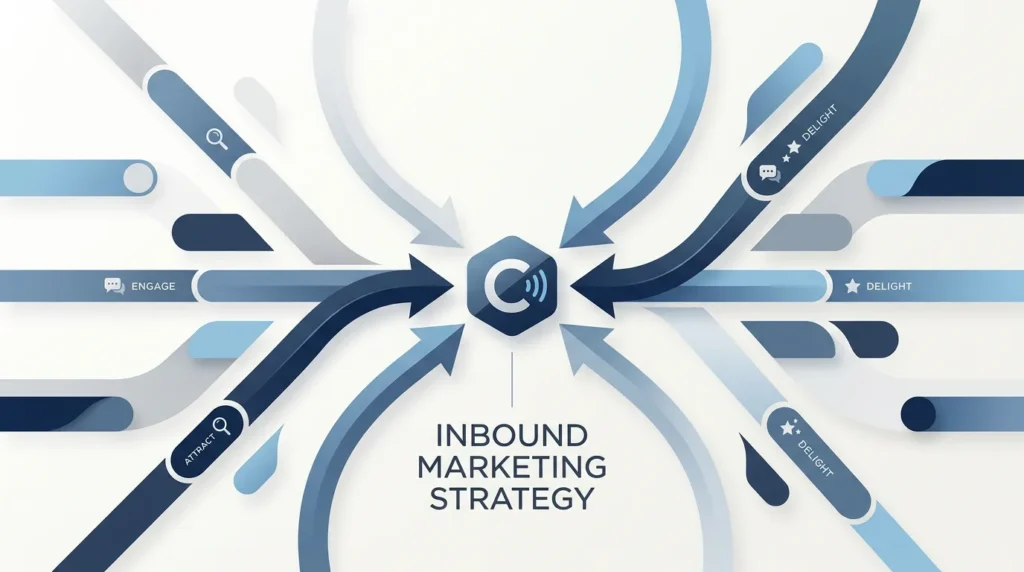
Let’s make it crystal clear, because the term inbound marketing is often used in a messy way online. Inbound marketing is essentially a method for attracting, engaging, and helping people, using valuable content and a strong customer journey. A commonly used breakdown is attract, engage and delight. (hubspot.com)

Typical deliverables you can expect

  • Content plan (what we create, for whom, and why it helps people choose).
  • SEO (Search Engine Optimization), meaning planning and optimisation so you become discoverable for relevant search queries.
  • Landing pages with conversion in mind, including clear Call to Action (Call to Action, CTA).
  • Lead nurturing and follow-up, so prospects do not drop off as soon as they download or sign up.
  • Conversion optimisation, in other words improving Conversion Rate (Conversion Rate, CVR) based on data.
  • Tracking and reporting so you know what works and what doesn’t, not just by gut feeling.

What inbound marketing is not

  • Not a one-shot campaign. Inbound is about an ongoing system, not a one-time “dropping content”.
  • Not a magic lead machine. You can speed things up and optimise, but you still need to build a realistic pipeline.
  • Not a replacement for sales. In growth, marketing often needs to work alongside Sales Qualified Lead (Sales Qualified Lead, SQL) definitions and follow-up. Otherwise, it stays at interest, not customer value.

The strategy behind inbound marketing, without the smoke and mirrors

If you ask us why inbound marketing works, our honest answer is: because online human behaviour keeps showing patterns. People first look for information, compare options, and only decide later. If you offer the right information on the right page at the right moment, your brand becomes “the logical choice”. That sounds soft. It is actually very measurable.

1) Attract: building visibility and relevance

Attract is mainly SEO and content that answers real search queries. That means:

  • choosing topics based on what your target audience searches for;
  • creating content that truly solves those questions;
  • having your technical foundation in order, so Google can find and understand your pages.

For the technical and indexing side, Google Search Console (Google Search Console, GSC) is one of the most important tools for insights. Google describes Search Console as a tool to monitor, optimise, and troubleshoot your presence in Google Search. (support.google.com)

2) Engage: from visit to intent

Engage is about the question: “Why would I get in touch now?” That is why your website needs to respond logically to different intent levels. Think about:

  • landing pages that are specific to a use case;
  • forms and CTA’s that fit the stage in the funnel;
  • nurturing that does not spam, but helps people choose.

Important, and this is often misunderstood: not every form is automatically a Lead Generation result. A “lead” needs to be a person or company with genuine commercial interest, usually made identifiable through contact details or a concrete commercial request. Anything that only generates traffic, clicks or followers is therefore not yet a lead, unless you combine intent and contact.

3) Delight: why the return on investment only becomes truly visible here

Delight is not about being cosy. It is about retention, referrals, and faster time-to-value. Inbound is often explained through a flywheel model: attract, engage and delight reinforce one another. (hubspot.com)

For online sales optimisation, this usually means: better onboarding content, customer cases that help future prospects, and a feedback loop between sales, marketing and service.

What you get when you work together: quality, speed and measurability

A good inbound marketing company works with a clear method. Not because it sounds nice, but because otherwise you do not know what your next step should be.

Working methods that usually make the difference

  • Kick-off and target-audience sharpening: together, we define your ICP (Ideal Customer Profile, ICP) and key pain points, so content is not made “for everyone”.
  • Content and SEO planning: we build a content backlog with priorities, so you are not starting over every month.
  • Testable hypotheses: every page or campaign gets a measurable goal, for example CVR to appointment or enquiry.
  • Meaningful reporting: KPI’s (Key Performance Indicator, KPI) that translate directly into funnel outcomes, not just vanity metrics.

What we measure concretely, and why

We focus on metrics that measure behaviour and conversion, not just statistics. For online inbound, that is often:

  • SEO: visibility and organic performance per landing page (with GSC as the baseline). (support.google.com)
  • Conversion: CVR per page and per CTA.
  • Lead quality: which Marketing Qualified Lead (Marketing Qualified Lead, MQL) turn into, and which SQL’s really continue toward sales.
  • Tracking quality: you need to be able to explain why something does or does not work.

For analytics, we typically use Google Analytics 4 (Google Analytics 4, GA4). Google has GA4 property documentation, which indicates that it is an analytics platform for reporting and insights. (support.google.com)

The trade-offs you need to know upfront

Let’s be honest, because inbound is not the same shortcut for everyone:

  • SEO takes time. If you are just starting out, content only becomes profitable later. SEA (Search Engine Advertising) can speed things up temporarily, but that is a different engine.
  • Lead quality requires discipline. Without clear definitions of MQL and SQL, nurturing becomes a guess.
  • Content takes attention. Good research, good copy and good landing pages are not “light work”.

So you do not just get a plan. You also get realistic expectations about time, effort and what you can improve when.

When is an inbound marketing company truly valuable?

You do not always need to outsource. But there are clear moments when working together delivers results faster, especially in B2B contexts or complex propositions.

Good reasons to choose an inbound marketing agency

  • You already have marketing, but you do not know which pages and content pieces generate leads with quality.
  • Your SEO is not working or has stalled. You are publishing, but you are not seeing structural growth in relevant search queries.
  • Your website looks “nice”, but your Conversion Rate (Conversion Rate, CVR) to appointments or enquiries is too low.
  • You have multiple products or use cases, but your go-to story is fragmented.
  • You want content and sales follow-up to connect better, so MQL’s do not lose momentum.

When it is better to fix things internally first

  • Your ICP and proposition are still too vague. Then an agency can create content, but it will not be right.
  • Your tracking is not reliable. Then you are improving based on noise.
  • Sales is not responding quickly or consistently. Then you get lead volume without pipeline impact.

The step-by-step plan: from audit to results in 30, 60 and 90 days

If you are considering working together today, you mainly want to know the first concrete steps. This is an approach we use often, because it creates clarity quickly.

0 to 30 days: audit, measurement plan and quick wins

  1. Quick inbound audit: we look at SEO basics, landing pages, forms, CTA’s and the flow to contact.
  2. Tracking check: we check whether GA4 and event tracking connect logically, so you can attribute conversions. (support.google.com)
  3. GSC analysis: we use GSC to understand indexing and search insights, so we can spot technical SEO issues and search opportunities. (support.google.com)
  4. Quick wins: often these are CTA adjustments, improved landing copy and removing friction in the form journey.

31 to 60 days: content and conversion testing

  1. Prioritise the content backlog based on intent and commercial relevance.
  2. Build or rewrite 2 to 4 landing pages for specific use cases.
  3. Improve lead nurture: you work with smart follow-up based on interaction, not just batch and blast.
  4. SEO execution: publishing with on-page optimisation and internal links.

61 to 90 days: pipeline focus and optimisation

  1. Adjust lead quality through MQL and SQL definitions, and alignment with sales.
  2. Optimise CVR per page and per CTA, based on real data.
  3. Reporting that drives action: your KPI’s should guide pipeline, not just reach.
  4. Iterate: scale what works; revise or stop what does not.

This is not a guarantee of fast results. But it is an approach that prevents you from building for months without learning.

Common mistakes when choosing an inbound marketing company

This is where it often hurts. So here is the honest list, so you do not take the same detour.

  • Looking only at content volume. Quality and fit with intent win. More articles says very little about better sales.
  • No agreements on measurability. If you are not clear about which KPI’s lead to pipeline impact, you are steering by feeling.
  • Tracking as an afterthought. Without good tracking, optimisation is a guess. And guessing is expensive.
  • Thinking about lead follow-up too late. Lead nurturing and sales follow-up are part of inbound, not something that “will come later”.

Your practical next step

If there is one thing you want to do today to move toward inbound marketing growth, it is this: make your inbound system measurable and repeatable. Start with a short audit, define your most critical conversion points (from visit to appointment or enquiry), and put your content and landing pages into a priority list based on intent.

Want inspiration for the content part? You can use this internal piece as a starting point: Inbound Marketing: Attracting Customers with Valuable Content. It helps you translate valuable content into customer questions in a concrete way. (And yes, it is easier than blogging at random.)

Conclusion: inbound is a system, not a campaign

An inbound marketing company is valuable when you work together to build an online sales system that learns through measurement. Attract with SEO and content, engage with landing pages and clear CTA’s, and delight with customer value and ongoing support. The core is simplicity, discipline and data.

If you choose to work together, pay extra attention to three things: a sharp ICP and proposition, reliable tracking and a plan you can actually execute. That way, you avoid turning inbound into a project that ends in a report instead of in your pipeline.

Shall we make it practical? Give us your current situation, for example your main product, your target audience, and where the conversion is currently stalling. Then we can outline a suitable step-by-step plan for the first 30 days.

Ready for a full calendar?

Book a free strategy call and discover how many leads we can generate for your business. No obligations — just a concrete growth plan.

Book your free strategy call →

Search Clicks Book your free strategy call — 30 min, no strings attached