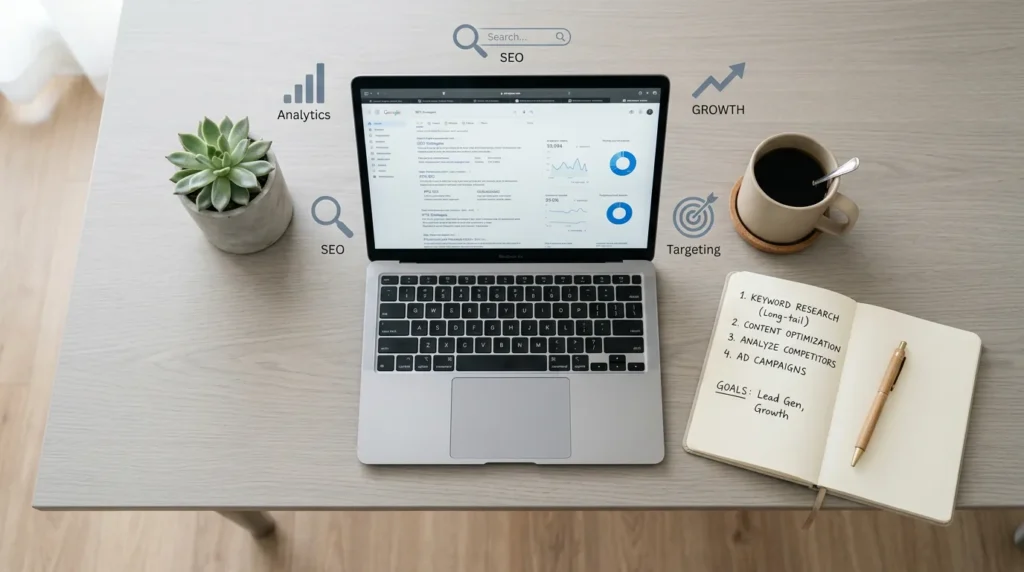
Search engine marketing agency: practical guide to growth
Written byDaniel van HekSearch Clicks·August 18, 2026
11 min read
Imagine your marketing team is an engine. You want power, but you also want to know why that engine does exactly what it does. That is exactly how we look at a search engine marketing agency. Not as “someone who runs campaigns”, but as a sparring partner that structurally improves your online sales and lead generation.
In this article, I’ll take you through the choices that matter. From strategy and tracking to landing pages and budget allocation. We’ll keep it practical, so you know what to expect, what to ask, and what the next step is.
What does a search engine marketing agency really do, and what not
The name sounds broad. In practice, a good search engine marketing agency usually revolves around three building blocks:
Search Engine Optimization (SEO) for sustainable traffic, with a focus on commercial search intent.
Search Engine Advertising (SEA) and Pay-Per-Click (PPC) for predictable growth, with a focus on conversions.
Conversion Rate Optimization (CRO) and landing pages that turn traffic into enquiries, calls and sales.
What an agency does less often well, but what you do want to see, is the connection between marketing and the actual commercial outcome. Think of:
Which actions are counted as a “conversion”, and why?
How is quality monitored, not just quantity?
How do we improve based on data, not on gut feeling?
This is often where the biggest gain is. Not in more traffic, but in better traffic. And that requires sharp definitions and solid measurement.
The strategy that works: from search intent to conversion
We see the same pattern in projects again and again. Companies invest in search engines, but optimise the wrong lever. That is why we always start with one clear question:
What do you want someone to do once they land on your site?
In online sales, that is usually one of these goals:
Form submission (for example an enquiry or quote request)
Phone contact
Booking a demo or appointment
Purchase (for e-commerce)
Only after that comes SEO or SEA. Not the other way around.
Step 1: choose a conversion set that matches your sales process
A conversion that does not match your commercial reality is almost always a data problem. In Google Ads, you want to measure conversions through the right setup. If you use Google Tag Manager (GTM), Google says you should configure the correct Google Ads tag within the right GTM container and link it to the correct Google Ads account. It also stresses that you want full conversion coverage, so Google Ads does not only observe part of what is happening. (support.google.com)
Why is this important? Because bidding strategy, budget allocation and conversion optimisation all depend on conversions. If those conversions contain noise, you are optimising for the wrong outcome. And then money goes to good intentions.
Step 2: split your approach between SEO and SEA, smartly side by side
SEO needs time. SEA can scale faster. But the best results often come when you let them work together.
If you want to unpack this topic properly, this is a useful deep dive:
Using SEA for quick validation of search intent and messaging.
Building SEO content and authority around the best-performing themes.
Using data from SEA to position SEO topics more sharply.
So you do not want “SEO in one corner, SEA in another”. You want one commercial learning loop.
Step 3: landing pages that match the search moment
A search engine agency can run campaigns down to the smallest detail. But the conversion happens on your page. That is why landing pages are not an afterthought. They are the moment where interest turns into action.
If you want to improve landing pages, look at best practices such as a clear message, minimal distraction and a call to action that fits the intent directly. It is also often stressed that your landing page is where “rubber meets the road”: if it is not right, you lose momentum. (searchengineland.com)
We often see the same mistake: the page is written for SEO, not for decision-making by your target audience.
What to ask when choosing a search engine marketing agency
When you choose an agency, you do not want a marketing brochure. You want proof of method. Here is a list of questions we ask ourselves too, because they quickly show whether the agency is a fit.
1) Which data do you use, and how? (not just which dashboards)
Good agencies talk about tracking, conversions and quality feedback. They talk less about “reporting” as a goal in itself.
For SEO, Google Search Console (GSC) is often the core source for performance information. Google explains that GSC shows overview reports about property health and also performance summaries, including clicks, impressions and top queries. (support.google.com)
In addition, you want to see that they take structured data seriously when it is relevant to your type of result. Google shows that GSC has tools to identify and fix structured data issues, and that rich result information is available to assess validity. (support.google.com)
Note: structured data is not a magic button. It helps when it fits your offer and your intended search results.
2) Which conversions do you count, and which not?
Ask for their conversion hierarchy. It is usually something like this:
Primary conversion, for example an enquiry or purchase
Secondary micro-conversions, for example scroll depth or viewing price information
And then: how does the agency prevent micro-conversions from overshadowing the primary optimisation?
This is also the place to discuss how they deal with conversion distortion caused by privacy settings. In that area, Google has published privacy-safe solutions, including context around consent and enhanced conversions. (services.google.com)
You do not need to become a tracking engineer. But you do want the agency to explain what may reduce or shift in measurement quality, and how they adjust their decisions for that.
3) How do you determine budget, and how do you adjust it?
An agency that only delivers a “nice report” is not enough. You want budget steering based on:
Cost Per Acquisition (CPA), here therefore the definition “CPA = Cost Per Acquisition”.
For lead gen: often also Cost Per Lead (CPL) alongside lead quality.
Conversion Rate (CVR) per step, not just overall.
Click-Through Rate (CTR) as an early indicator, but not as the end goal.
Important detail: we do not only assess “number 1 achieved”. We assess “steady improvement with a plan B”. That is what you want in your collaboration.
4) How do you integrate marketing with sales follow-up?
If you do lead generation, it does not stop at the form. Your CRM follow-up often determines the final quality of sales outcomes.
A mature agency therefore asks about:
Lead time, how quickly do we respond?
Lead qualification criteria, what is truly sales ready?
Feedback loop, which leads do and do not close?
That sounds simple. In practice, it is often forgotten. And then marketing seems “ineffective”, while the bottleneck is in response.
SEO, SEA and CRO by channel: what you should expect
Here it gets concrete. You want to know what happens in month 1, month 2 and month 3, per channel.
SEO: month 1 to 3, focus on commercial pages
In SEO, we usually want three things at the same time:
Choose relevant topics based on search intent and demand.
Optimise pages for conversion, not just for ranking.
Check technical setup and structured data where it makes sense.
If you want to approach SEO pragmatically, this is a good reference for approach and priorities:
Realistic note: SEO results do not come on day 1. You can still see movement quickly in indexing, improvements and topic fit. But sustainable growth takes time.
SEA and PPC: from week 1, focus on measurability and landing experience
SEA without conversion tracking is like fitting out a shop without a checkout. Google Ads has best practices for conversion tracking, and when you use GTM, there are clear instructions on how to set up the Google Ads tag correctly and that your conversion coverage must be right. (support.google.com)
What we do in the early phase:
Build campaigns based on intent, not just keywords.
Align ad copy with the customer’s problem and the offer.
Link landing pages to the ad promise.
Refine conversions so optimisation is accurate.
If you want to see Google Ads strategies in a way your team can use right away, this link fits well:
CRO: not “pretty tweaks”, but testing with clear hypotheses
CRO is the part where many agencies become too superficial. They make small optimisations without a real problem statement. We do it differently.
We start with hypotheses such as:
If the visitor does not understand what the offer is within 5 seconds, CVR drops.
If the page offers too many alternatives, then the click-through rate to the action drops.
If the form is too long, the conversion drops.
Why does that work? Because you reduce friction exactly at the points where decision-making gets stuck.
Trade-off: CRO tests take time. That is why we prioritise based on pages with traffic and pages that are already performing. No random experiments.
Practical next steps, so you do not just “give them a call” tomorrow
If you now decide to work with a search engine marketing agency, you want a clear route. Here is a realistic approach you can start in one to two weeks.
Next step 1: sharpen your conversion definition
Record what the primary conversion is for you. Also make a list of micro-conversions that support, not confuse.
Then check tracking via your implementation with GTM and Google Ads tags, and make sure your conversion coverage is correct. Google states that it is important for the Google Ads tag to be configured correctly within GTM and linked to the right account. (support.google.com)
Next step 2: audit your landing pages by intent
Take your top pages or your top SEA landing pages. Judge them on:
Is the message directly linked to the search intent?
Is the offer clear, including proof and expectations?
Is the action logical and easy to complete?
Is there enough information to remove objections?
If you also want to include your marketing website in optimisation, this is relevant:
Next step 3: start a plan with 30 days of measurable improvements
Within 30 days, you want to be able to say something about:
Which search themes or ad variants perform best in qualitative terms.
Which pages improve CVR, and why.
Whether your CPA or CPL moves in the desired direction, while maintaining quality.
Reality: you will not win everywhere at once. But you do need to see a clear learning cycle.
Next step 4 (optional): choose a specialty if your offer is complex
For example, do you have e-commerce? Then it makes sense to place extra focus on Shopping campaigns and feed quality. If you want practical attention there:
And if you run a hotel or accommodation business, there is a specific route via Google Hotel Ads (where you can influence bookings through Google’s hotel ads). Practical entry:
When you should not start yet, and what to do then
Here are situations where we usually first make adjustments before going “full throttle”:
Tracking is not reliable. Without conversion data, optimisation is a guess.
Sales follow-up is missing or slow. Then your marketing seems weak, while response is the problem.
Landing pages are not aligned with intent. Traffic is then wasted.
There is no clear ICP (Ideal Customer Profile). Then you do get enquiries, but not the right ones.
Dry humour for your dashboard: “Traffic is not the problem, but it does create the impression that the issue is happening on the other side of the form.”
In other words: get the basics right first, then scale.
Conclusion: a search engine marketing agency is only good if it improves your sales process
A search engine marketing agency is not a supplier of disconnected campaigns. It is a team that turns online visibility into commercial action. If you ask the right questions and have your measurability in order, the difference becomes visible.
In summary, we recommend this:
Define conversions that truly match your sales process.
Let SEO and SEA work together on intent and messaging.
Invest in landing pages that support decision-making.
Optimise with CRO based on hypotheses, not opinions.
Adjust with a 30-day learning plan, so you can see progress.
If you want, you can take the next step by making one conversion set and one intent map internally. Then you will know exactly what input you need from an agency. And trust me, that makes every conversation a lot more productive than “we’re going to do SEO”.
Book your free strategy call — 30 min, no strings attached
Cookies on this site
We use analytics cookies to see how the site is used. They are only placed if you agree. Refusing costs you nothing — the site works exactly the same. Privacy statement