
 Written by
Daniel van Hek
Search Clicks·August 27, 2026
11 min read
Written by
Daniel van Hek
Search Clicks·August 27, 2026
11 min read
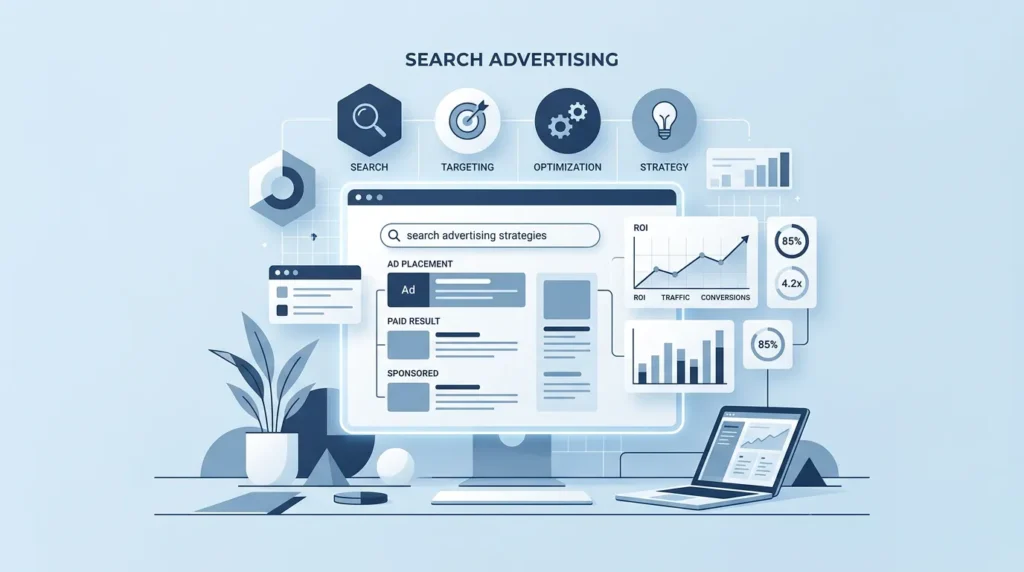
When you say “SEA campaign”, we mean Search Engine Advertising: paid advertising in search engines. And yes, it can burn money fast. But it can also become exactly what you need if you build it as a system, not as a standalone ad.
In practice, I often see the same pattern. We start with a few keywords, create a few ads, and set a budget. Then we start steering on clicks. And then, usually after a few weeks, we discover those clicks do not lead to conversions. Sometimes it is the targeting, sometimes the message, and often the landing page where people end up.
The strategy is therefore simple but strict: we design a SEA campaign around intent. We make sure your ad matches the search query. We make sure your landing page matches what you promise. And we measure every step properly, so your optimizations are based on facts, not gut feeling.
Your SEA campaign is only as smart as your measurement plan. So before we start adjusting ads and keywords, we need to define what counts as “success”.
Concretely, we ask ourselves:
Why this works: Google can only learn if conversions come in consistently and reliably. Google itself states that Quality Score looks at expected click-through rate, ad relevance, and landing page experience, among other things. If your landing page and promise do not align, the experience is off. You can see that reflected in performance, such as expected click-through rate and landing page signals. (support.google.com)
At minimum, we want:
Google specifically recommends the correct conversion tag path for Google Ads. Google explains how to use the Google tag for conversion tracking and when you should not add it again. (support.google.com)
If you work with Google Tag Manager, follow Google’s guidelines for measuring conversions and sending events. Google also describes methods to measure conversions and combine them with platforms such as Google Analytics 4, depending on your setup. (developers.google.com)
Practical trade-off: a perfect measurement setup takes time. But a poor measurement setup costs much more money, because your budget optimization then runs on the wrong signals.
You can build SEA campaigns like a spreadsheet. Or you can build them the way a salesperson works: by type of question, by expectation, by next step. We do the latter.
A workable foundation is:
Why this works: your ad and landing page can then speak the same language as the search query. That increases the chance of a click and the quality of the experience after it.
We start with a set of keywords that fits your Ideal Customer Profile (ICP). Not because we think it is romantic, but because otherwise we get a lot of clicks from people who will never move forward.
Concretely in the setup:
Now comes the part most teams rush through. They write an ad copy and hope it lands well. But your ads should mainly set the right expectation.
Google works with responsive search ads. Google explains that by using different headlines and descriptions, you help the machine choose combinations that are relevant to the user. (support.google.com)
This is how you handle it professionally:
Practical tip: test your landing page for match first. If the page does not align, a strong ad is not very useful. The ad may attract attention, but the experience will not fit, and that hurts quality and conversion.
Google uses Quality Score as an indicator of usefulness and experience. Google names elements such as expected click-through rate, ad relevance, and landing page experience. (support.google.com)
What we do in practice:
And yes, sometimes it takes a while before signals improve. Google notes that Quality Score uses historical data and that there is time between updates and enough performance data. (storage.googleapis.com)
A landing page is not a digital business card. It is your sales conversation in one screen, plus the next step. If that page does not work, you only correct the SEA campaign after it has already done damage.
We build a page around one primary action, such as a form or an appointment. On top of that, we make sure of:
We do CRO (Conversion Rate Optimization) in short iterations. Start with the biggest lever:
Trade-off: too many tests at once make your data confusing. We test one change per round, or at least one clear variant, so we can learn.
Your goal determines your bidding strategy. If you primarily optimize for CPA (Cost Per Acquisition), you choose consistent conversion behaviour. If you optimize for ROAS (Return on Ad Spend), you must measure conversion value consistently.
Important: neither of these strategies is “magic”. It is learning based on signals. That is why a stable measurement setup is so important.
Responsive ads perform better when your assets are logical and complete. Google notes that responsive search ads give more headlines and use AI to assemble combinations. (support.google.com)
We apply that in practice by:
You have GA4 and GSC, but a dashboard nobody uses is like a coffee machine without beans. You can see something moving, but you cannot drink it.
We keep it simple:
If you are also working on SEO to build organic reach, you can connect the plans smartly. Useful if you are starting from visibility and content structure, for example via Google visibility: a complete SEO approach that sells or, for WordPress, via WordPress SEO: practical growth checklist.
And if your landing page and content also want to benefit from AI-driven search results, this is relevant: AI Search Engine: How AI-driven search results work.
When we do this for a client, we start with a compact sprint. No months-long brainstorming, but choices you can test right away.
If you also want to sharpen your website and conversion path, it helps to look at costs and approach. For example: Website creation pricing: costs, choices and approach or Website creation cost: realistic pricing overview 2026. And for SEA itself, you can follow the operational route via Set up a Google Ads campaign: step by step and Google Ads costs: what does advertising on Google cost?.
A good SEA campaign comes down to three things: match, measure, and learn.
If you want to take one step tomorrow, choose this: first tighten your conversion goal and tracking, then build an intent-driven campaign structure, and only then optimize your ad copy and landing pages in a focused way. That is boring. And that is exactly why it works. (The coffee tastes better then too, by the way.)
Do you want us to translate this into a concrete plan for your situation? Then we need input about your ICP, your primary action, your current landing page, and your desired CPA or ROAS direction. After that, we will create a campaign setup we can test within days.
Extra suggestion for long-term pipeline: SEA campaign helps you fast, but if you want sustainable growth, also look at an inbound marketing strategy. For example via Inbound marketing strategy: how to build a sustainable pipeline. And if your team often optimizes manually, AI support in your marketing process may be relevant, see AI Automation: making marketing processes smarter.
Note: I cannot promise guaranteed results. What we can guarantee is that with the approach above, you get a campaign that is logically built, measurable, and quick to improve. That is the real win in Search Engine Advertising.
Book a free strategy call and discover how many leads we can generate for your business. No obligations — just a concrete growth plan.
Book your free strategy call → Book your free strategy call — 30 min, no strings attached