

Let’s be honest. “Inbound marketing” often sounds like just a broad term for “posting more content”. But when we do it right, inbound is about one thing: helping the right people move forward in their buying journey without interrupting them. In practice, that’s how you build pipeline, because you stay relevant at the right moment and make your offer easy to understand and compare.
In this article, we’ll walk step by step through an inbound marketing strategy your team can start using today. Warm, direct, and focused on online marketing and online sales optimization. No magic tricks. Just an approach that works because it matches how people search for information, weigh options, and decide.
1) What an inbound marketing strategy is, and what it is not
Inbound marketing is about a cycle that moves people from “they haven’t heard of us yet” to “I want to talk”. A widely used model is attract, engage and delight, where content and experiences help move someone from unknown to customer and from customer to advocate. (blog.hubspot.com)
What it is not:
- A content calendar without a measurable goal.
- Sending traffic to your website and hoping it converts on its own.
- Collecting leads without qualification, follow-up, and sales alignment.
The core we do tackle in a strong inbound marketing strategy:
- You understand your ICP (Ideal Customer Profile) as a commercial profile, not a marketing persona.
- You choose content and pages per stage in the buying journey.
- You make conversion measurable and steerable through landing pages and CRM follow-up.
- You protect quality with E-E-A-T, because search engines mainly want valuable, reliable content. (developers.google.com)
2) Start with ICP, intent, and the decision questions behind your keywords
If your ICP is vague, your content becomes vague too. Then you may get traffic, but very little real commercial interest. So we start with three concrete things.
2.1 Define your ICP in marketing and sales language
Use your data from CRM, intake forms, and sales conversations. Don’t write your ICP down as “companies with 10 to 50 employees”. Write it down as decision logic:
- Which function or role has the problem?
- What is the trigger to take action now?
- Which objections keep coming back?
- When is someone “ready to talk to us”?
2.2 Connect search intent to TOFU, MOFU and BOFU
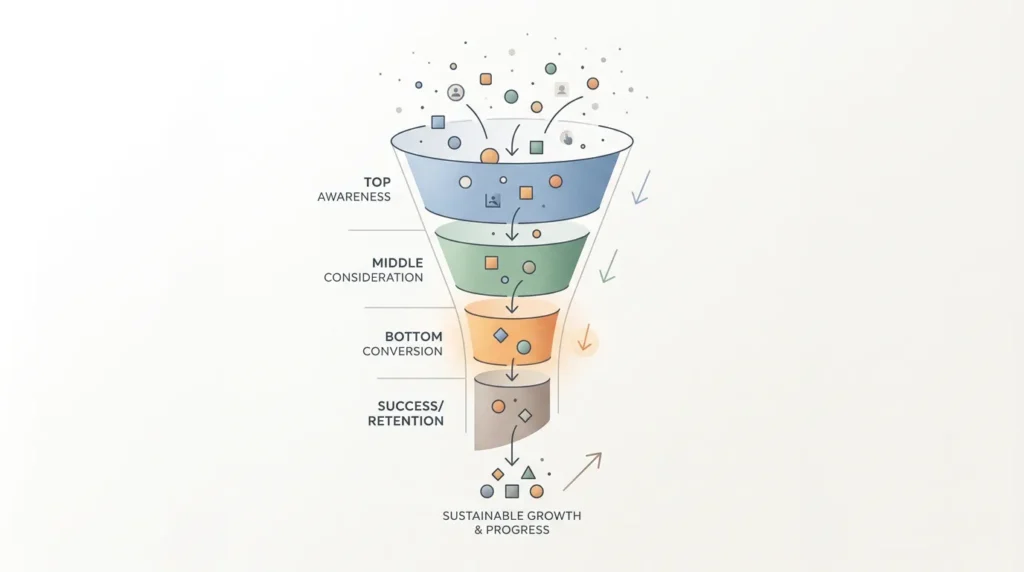
TOFU, MOFU and BOFU (Top, Middle and Bottom of the Funnel) are not a magic framework. They mainly help you structure your content by goal. In practice:
- TOFU: someone is exploring and wants to understand what the problem and options are.
- MOFU: someone is comparing, digging deeper, and wants to know what fits their situation.
- BOFU: someone is ready to choose and act, so your page should support the decision.
Important: if you try to sell BOFU content to TOFU visitors, friction appears. Then your conversion drops and you get poor-quality leads. This is exactly why funnel mapping is so important in inbound. (semrush.com)
2.3 Choose content topics based on decision questions
We like to do this as a simple one-hour exercise:
- Take 30 search queries or topics your target audience uses (from search data, internal sales questions, or keyword research).
- Ask per topic: “What decision are they almost making?”
- Put each topic into TOFU, MOFU, or BOFU.
- Note what type of page they actually need (guide, checklist, comparison, case, demo-style page).
After this, you automatically know what to publish and what you can better skip.
3) Content that converts: attract with credibility, engage with choices, delight with follow-through
In inbound, content is not a “post”. Content is a tool in the buying process. That means every page has a role and includes a clear next step.
3.1 Attract: prove you really understand the topic
Search engines reward helpful, people-first content. And E-E-A-T is one way to describe quality: Experience, Expertise, Authoritativeness and Trustworthiness. Google explicitly links this to the idea that content is assessed on reliability and substance. (developers.google.com)
In practice, this often works well in inbound:
- Make experience visible: examples from implementations, common mistakes, what you have seen in sales cycles.
- Practical frameworks: “Here’s how to tackle X” with steps, not just definitions.
- Transparency about limitations: “This works especially well if…, not if…”
From experience: the page that converts best is rarely the longest. It’s the page that removes the visitor’s uncertainty the fastest.
3.2 Engage: turn attention into a choice
Engage in inbound is about guiding your visitor toward a next step. Think lead capture, but also context. A visitor wants to understand: “Does this fit me, and if so, what happens next?”
In MOFU, this often works well:
- Comparison pages, without marketing fluff, with clear “when do you choose what”.
- Use-case guides, linked to role and situation.
- Objection handling on landing pages, because objections often surface there.
If your team wants to turn this into a broader approach, you can also take a look at Inbound marketer: strategy that really builds pipeline. That focuses on connecting content with pipeline logic.
3.3 Delight: support customer value, not just the signature
Delight is not a “thank-you email”. Delight means setting up onboarding, adoption, and follow-up so customers feel value faster. That matters for retention and referrals, but also for your feedback loop on content and targeting.
Practically speaking:
- After a demo or trial, ask for short feedback with a structured form.
- Use that input to improve your MOFU and BOFU pages (FAQs, implementation steps, success criteria).
- Create a knowledge base or guides that solve problems, not just tell brand stories.
4) Conversion engine: landing pages, forms, and CRM follow-up
Inbound only works commercially when you capture and follow up on conversions properly. So we build a conversion engine. No complexity for complexity’s sake, but discipline.
4.1 One page, one intent, one next step
A landing page should carry over the promise from your content or channel. If your TOFU article is about problem recognition, then your TOFU landing page should logically be informative. If your landing page only offers “book a demo”, you’re pushing too hard. That lowers your CVR (Conversion Rate) and adds extra noise to your pipeline.
What you can standardize:
- A clear headline that names the visitor’s situation.
- A short form with only the fields you really need for qualification.
- Proof: what is the typical result, what is the approach, who guides this?
- A CTA (Call to Action) that fits the funnel stage.
4.2 Qualify with MQL and SQL, not with “an email address and hope”
If you treat everything as a lead, everything also becomes expensive. That’s why we deliberately split Marketing Qualified Lead (MQL) and Sales Qualified Lead (SQL). Define MQL as “marketing has enough signal to pass it on”. Define SQL as “sales can confirm the need and timing”.
That way, you prevent your sales team from wasting time on unrealistic appointments.
4.3 Measurable follow-up in CRM
CRM (Customer Relationship Management) follow-up is where inbound often leaves money on the table. Not because teams don’t send emails, but because they don’t have rhythm and quality rules.
A practical approach:
- Within 5 to 15 minutes after form submission, send a relevant confirmation or next step.
- Segment based on the content someone requested (for example: guide A versus handbook B).
- Sales outreach based on SQL criteria, with a clear reason why contact now makes sense.
And yes, this is also where you use automation intelligently. But again, automation should lead to better efficiency and better lead quality, not just more system load.
If you want to think about how to make your marketing processes smarter with automated steps, this article fits well: AI Automation: Making Marketing Processes Smarter.
5) Distribution and channel mix: where inbound really wins (and where it doesn’t)
Inbound is not one channel. You win by orchestrating distribution. But we keep it practical, because there is always a limit to team time.
5.1 SEO and content: durable demand, but with lead time
SEO means Search Engine Optimization. The advantage is scalability. The downside is time. So we combine SEO with faster channels to fill pipeline sooner while SEO grows.
Make it measurable through GSC (Google Search Console) and analysis in GA4 (Google Analytics 4). Don’t just evaluate rankings. Look at page performance, conversion, and behavior after arrival.
When you really want to give SEO focus and structure, Search engine marketing agency: practical guide to growth can serve as a roadmap.
5.2 SEA as a supplement: Search Engine Advertising for intent moments
SEA means Search Engine Advertising. Use SEA for moments when intent is ready to buy. Think of search queries that are already moving toward MOFU or BOFU.
Important: don’t just send SEA traffic to your homepage. Landing pages with the same intent increase your chance of conversion and lower your cost per acquisition or action. A starting point for how to set this up can be found in Advertising on Google: Getting started with Google Ads (guide).
5.3 Social and communities: not for viral dreams, but for consistent trust
Social media marketing agency work is effective when you treat it as a distribution channel for proof and education, not as a place to sell hard. If you want to shape this professionally, Social media marketing agency: strategy and approach helps create structure.
6) Measuring and optimizing: KPIs, experiments, and what to check first
Your inbound marketing strategy should give your team the feeling: “We know where the friction is.” That’s why we don’t just measure output; we measure quality and flow.
6.1 KPI set that fits inbound
A healthy set of KPI (Key Performance Indicator) for inbound online marketing:
- CVR per landing page and per funnel stage.
- CPL (Cost Per Lead) for MQL and SQL separately, not one average for everything.
- Opportunity to customer conversion in your CRM, so you understand whether marketing also delivers sales quality.
- Response time after lead capture (SLA and follow-up speed).
Note: you can generate lots of leads and still end up with a poor pipeline. That’s why we split MQL and SQL.
6.2 Experiments in an order that saves time
If you want to optimize everything at once, you’ll lose weeks. We do it in order:
- Check tracking: GA4, GSC and CRM mapping must be correct, otherwise you’re optimizing smoke.
- Improve landing pages: headline, layout, proof, CTA, speed.
- Improve content fit: match topic and funnel stage, remove what doesn’t belong.
- Improve follow-up: timing, segmentation, and sales handoff rules.
- Shift channel budget only based on underlying conversion and lead quality.
6.3 E-E-A-T as “quality you can execute”
E-E-A-T is not just about words. It’s about design choices that build trust. Google explains in its own content that E-E-A-T appears in how content quality is approached, together with rater guidelines. (developers.google.com)
Practical execution we often see with teams that move faster:
- Make authorship and expertise visible (who writes, why the topic is theirs).
- Work with internal reviews from people who actually do the work.
- Update content when reality changes, and note what’s new.
This is not a guarantee for rankings. It is a consistent way to increase your chance of valuable visibility.
7) Team and execution: when to build internally, and when to get support
You can build inbound internally, but you do need capacity for strategy, content production, CRO, tracking, and sales alignment. That is often more work than teams expect.
If you’re considering bringing in specialized support, it helps to first get clear on what you need:
- Do we have a content funnel that fits TOFU, MOFU and BOFU, or are we usually missing MOFU?
- Do we have landing pages that respect intent, or do we send everyone to the same form?
- Is CRM follow-up consistent, or does it depend on who happens to be on shift?
- Can we define and measure MQL and SQL, or is it mostly manual?
If you translate this into a search and selection process for execution, Best Online Marketing Agency: selection guide and comparison can help you bring structure to your choices. And if you want to lean more into inbound, Inbound Marketing Agency: expertise for growth. Brief fits the scope and communication side.
If you mainly need overall online marketing solutions, you can look at Digital Marketing Agency: modern marketing solutions.
Conclusion: your next step to improve inbound today
If I reduce it to one practical route, it’s this:
- Make your ICP and funnel decision questions concrete (TOFU, MOFU, BOFU).
- Create one truly helpful page type per funnel stage and connect it to a clear CTA.
- Set up landing pages and CRM follow-up so you can measure MQL and SQL quality.
- Optimize in the right order, first tracking and page fit, then follow-up, and only last channel budget.
A small warning, with a smile: inbound marketing is not a sprint. It’s a system. And systems win because they keep learning.
If you’re looking for an extra tactical addition for fast conversations outside SEO, then Cold Email: Effectively Approaching New Prospects (Guide) can help improve follow-up and meeting opportunities. But keep your definitions sharp there too, so inbound and outreach together form one logical whole.
If you want the whole approach to become even more concrete, Inbound marketing: the practical guide to more pipeline connects well with what you need to set up today and what you can scale later.
