

Alright, grab your coffee. If you’re searching for “sea budget” today, you really want one thing: how much money should we put into Search Engine Advertising without feeling like we’re guessing. We see it in practice almost every week: teams want quick results, but budget decisions are exactly what shape how fast Google Ads learns, optimizes, and measures conversions.
In this guide, we make it concrete. We explain how to set a SEA budget, which cost structure you should expect, how to estimate ROAS (Return on Ad Spend) and Cost Per Acquisition (CPA, in this context CPA is the cost per acquisition, so per conversion with commercial value) realistically, and how to divide spend across campaigns. You’ll also get a next step you can still carry out this week.
1) What “sea budget” means in Google Ads in practice
“SEA budget” sounds like one number. In reality, it’s a set of choices. Your budget determines, among other things:
- How often your ads can run (and therefore how much data you collect).
- How quickly your campaigns come out of learning phases after changes.
- Whether your goals are achievable within your pace and market competition.
With automation, the bidding system uses data to optimize bids. Google says that with automated bidding you do not always need to set your bid limit the same way as with manual bidding, because you keep control through your budget. (In other words: budget is your control knob.)
In addition, the system uses “learning phases” after new campaigns or significant changes. That’s not meant to annoy you, but to calibrate. Google explains that campaigns need time to optimize and that major changes can disrupt the process. (support.google.com)
Practical takeaway: if your budget is too tight, you’ll mostly be financing “not learning.” Then you may see KPIs that look like inconsistency. If your budget is too generous, you increase speed, but also your risk of inefficient spend if your tracking and targeting are not yet in order.
2) Cost structure that directly affects your budget
Let’s keep it simple. Your SEA budget needs to fit your cost per click and your conversion behavior. That’s why you need to look at at least these building blocks:
Click costs, CTR and CPC as the starting point
In Google Ads, part of your reality is: Cost Per Click (CPC) and Click-Through Rate (CTR). CTR says something about how relevant your ad is to the search query. CPC says something about how competitive the auction is for that click.
There is no universal formula, so you work with real data. What you should correct for:
- Seasonal effects (sometimes you only see later that your budget was set too late).
- Campaign type (Search vs Shopping vs Display and other variants have different dynamics).
- Conversion lag (conversions are not always “instant” and can come in later).
Conversion tracking and privacy affect your performance insight
If conversions are not measured reliably, you end up optimizing on the wrong signals. Google therefore recommends using enhanced conversions and links this to a strong consent framework (Consent Mode). Enhanced conversions is a measurement solution that uses your first-party data to make conversion measurement more accurate. (support.google.com)
Also interesting: Google says that conversion modeling via Consent Mode helps recover ad-click-to-conversion journeys lost because of consent choices. (support.google.com)
Practical takeaway: if your tracking is still “basic,” put a measurement improvement on the roadmap first. A higher budget on top of poor measurement quality feels like pouring more water into a leaky bucket.
Budget limits and the bidding status “Limited by budget”
Google uses statuses that show why optimization is limited. If a campaign is “limited by budget,” that can affect how often your ads are shown and the effectiveness of your bidding strategy. Google also notes that there are updates in how the system handles budget-limited situations and that it is important to follow best practices. (support.google.com)
You don’t need to read this like a data analyst. But you do need to recognize it. If your budget is too low, your campaign is not becoming “inefficient because of you,” but because the system gets less room to optimize.
3) How to calculate a SEA budget with a realistic ROI estimate
Here we do something many teams skip: we separate estimate from decision. We use a short calculation, but we treat it as a starting point, not fortune-telling.
Step 1: choose your target KPI with clear definitions
For SEA budget setting, you need at least one of these goal types:
- ROAS (Return on Ad Spend): how much conversion value you get back per euro of ad budget.
- CPA (Cost Per Acquisition): the cost per acquisition, or per conversion with commercial value.
- CPL (Cost Per Lead): the cost per lead, but we mean a commercially interested person or organization with clear commercial intent (so not just a “visitor” as a lead).
We recommend normalizing value first. So: what counts as an “acquisition” in your business? A quote request? A purchase? A demo request? Make this explicit in your measurement. If you do not have this clear, budget setting becomes a hobby instead of marketing management.
Step 2: estimate conversion volume and CVR, not just clicks
CVR (Conversion Rate) is simply conversions divided by clicks. If you want to hit target CPA or target ROAS, you need to know which CVR you can realistically expect per campaign, search term cluster, and landing page.
Practical model:
- Expected clicks = your budget divided by your average CPC (based on historical data, adjusted for a new campaign situation).
- Expected conversions = expected clicks multiplied by CVR.
- Expected CPA = budget divided by expected conversions.
- Expected ROAS = conversion value divided by budget.
Where this can go wrong: CVR shifts if your landing experience changes, traffic changes, or if conversion measurement is improved. That’s why this is a range, not one number.
Step 3: build in a range for learning phases and measurement delay
Google says that bidding strategy and campaign optimization need time, especially after changes. (support.google.com)
So when planning your budget, take two scenarios:
- Conservative: lower CVR or higher CPA during part of the first few weeks.
- Optimistic: faster recovery after calibration and a better match between search intent and landing page.
Your goal is not to “plan perfectly.” Your goal is to “test wisely from a financial point of view.”
Quick rule of thumb we often use: choose a starting budget that gives you enough data to make decisions, but plan your optimizations as iterations. Instead of turning the screws all at once. (And yes, we still say that even if someone finds it scary to tweak on day 1.)
4) How to divide budget across campaigns so you are not over-optimizing everything at once
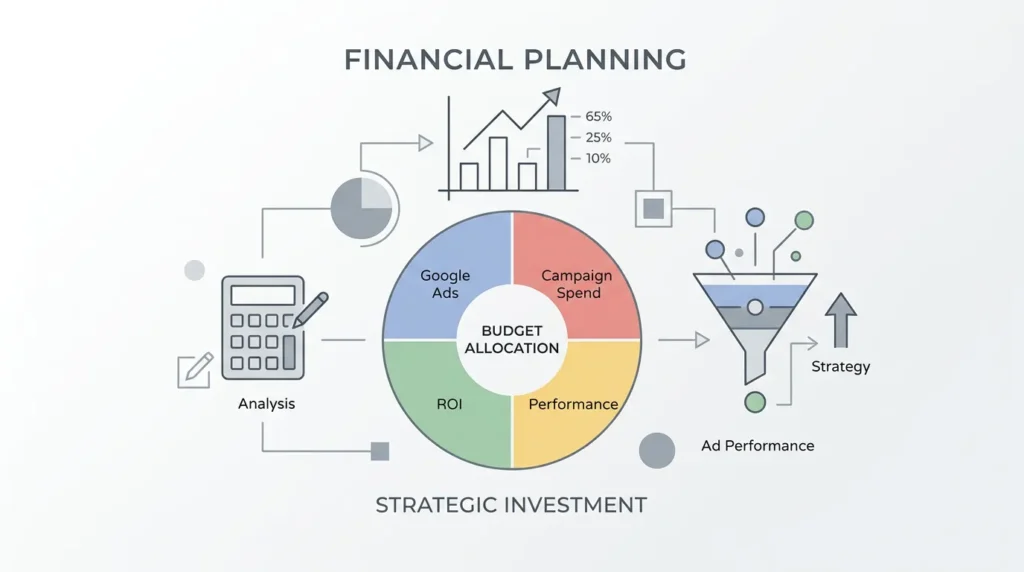
Now comes the part that really determines whether your SEA budget works: allocation. You do not want everything to get “a bit.” You want every budget to have a reason.
Use an allocation logic per campaign type
A practical split that often works:
- Focus campaigns (60 to 80%): where you already have proof that traffic converts. This is where you want volume and stability.
- Test campaigns (10 to 25%): new search intent clusters, new ad copy, new landing page variants. This is where you learn.
- Risk buffer (5 to 15%): for seasonal peaks, bidding strategy adjustments, or measurement fixes (for example conversion tracking improvements).
This is not a law of nature. But it is a framework that prevents your budget from disappearing into “random change.”
Do not just measure clicks, measure the path to commercial success
If your goal is ROAS, your conversion value needs to be correct. If your goal is CPA, your acquisition definition needs to be consistent. If you use CPL, your lead quality needs to be secured.
We often see teams discover too late that tracking is good enough to report clicks, but not good enough to steer performance. If that is where you are, it is smart to work on your measurement foundation in parallel with your budget choice.
Optimize budget together with SEA optimization, not separate from it
Budget without optimization is like a turntable without a needle. You get sound, but you lose precision.
If you set your SEA budget based on goals, create a rhythm of improvement. A method like the one in this internal explanation of SEA optimization and continuous improvement fits that: SEA optimization: continuously improve campaign marketing.
Next step: make one campaign “budget-driven” and one “learning-driven”
You can already do something this week without overhauling your entire account:
- Choose one campaign that is already working and assign it the biggest budget share.
- Choose one campaign you want to improve through tests (search intent, landing page, ad copy).
- Define one KPI per campaign that you want to see move over 14 to 30 days, not by feeling, but by data.
That way you create predictability, and at the same time you build evidence for future budget scaling.
5) Common SEA budget mistakes and how you avoid them
Mistake 1: changing the budget too often, giving the bidding system too little room to settle
Google says that budget changes can affect how ads are shown and how often you are charged. (googlesupport.serverhump.com)
Practically speaking, if you change the budget every day, you make it harder for optimization to learn stable patterns. Prefer planned changes: one change, then room to evaluate.
Mistake 2: basing your calculation on yesterday’s traffic, not today’s intent
If search terms change, landing pages change, or consent impact shifts, CVR changes. Your budget model therefore needs to be fed by real data and have its assumptions updated.
Mistake 3: your definitions are not commercially sharp enough
If “conversion” in your reports is not the same as “acquisition that generates money or is valuable for pipeline,” then you are steering on noise. Then your SEA budget will sooner or later get out of hand.
Mistake 4: you treat every lead as a lead, but do not qualify
In lead generation, lead quality matters. A visitor who opens a form can be commercially valuable, or not. For B2C, the rhythm is often different from B2B.
If you do B2C and want a measurable system, a method like the one described here fits: B2C lead generation: strategy, channels and a measurable system.
Conclusion: your SEA budget is a plan, not a guess
If you sum it up, “sea budget” comes down to five decisions:
- Which KPI drives your budget (ROAS, CPA or CPL), with a commercial definition.
- What your expected CPC and CVR range is based on real data.
- Whether your conversion tracking is in order, including enhanced conversions and consent framework where relevant. (support.google.com)
- How we divide spend across focus, tests and buffer, so we learn without chaos.
- Which optimization rhythm we follow after changes, so campaigns can calibrate instead of starting over each time. (support.google.com)
And now the practical next step. Today or tomorrow: choose one working campaign as the focus, one campaign as a learning-driven test, and define one measurable KPI per campaign for the next 14 to 30 days. Then scale. That is how you turn your SEA budget into steering power, not into a budget-burning exercise.
If you also want to tighten up your website and acquisition system, take a look at this route from traffic to SQL through a system: Lead generation site: from traffic to SQL with a system. And if you want to build your SEA setup step by step, this is a useful foundation: Set up a SEA campaign: strategy to execution (step by step).
Finally, if you notice that you do not have enough internal time for execution and optimization, then choosing the right agency becomes a strategic task. Start with selection criteria like these: Choosing a SEA marketing agency: selection criteria and then use the broader approach here: Choosing a SEA marketing agency: strategy and execution. If you want a broader view, this page is useful for context: Online marketing agency: services and specializations and for the combination with SEO: SEO marketing agency: combining SEO and marketing smartly. For the bigger picture around online leads, this also helps: Generate online leads: use digital channels smartly.
