

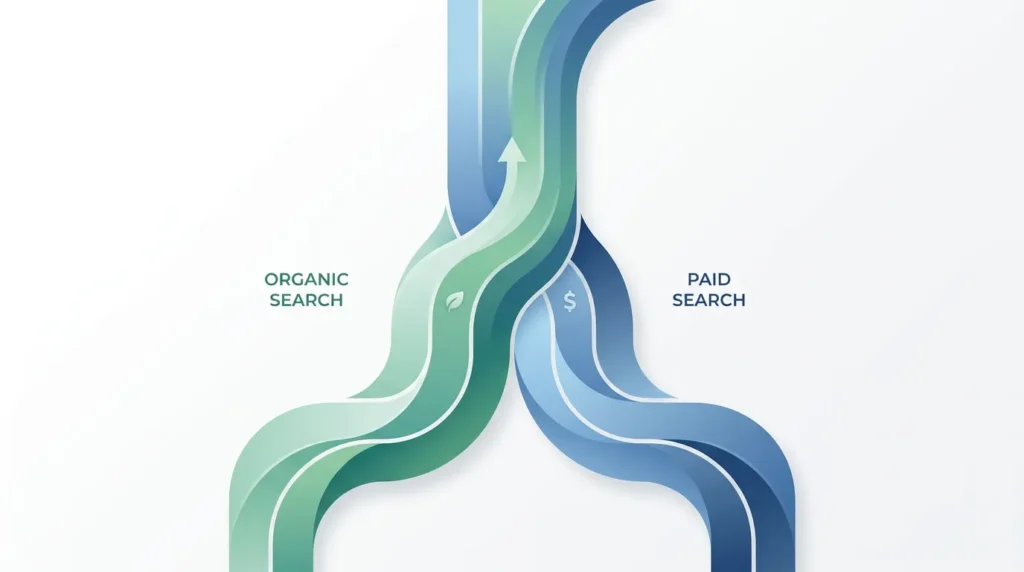
You probably know the feeling: we do SEO, we do SEA, and yet it still feels like we’re doing double work. SEO focuses on “visibility”, the ads capture “revenue”, and somewhere between the two lies a kind of digital no-man’s land. Today, we’re making that landscape walkable again.
In this article, I’ll show you how to combine SEO and SEA (Search Engine Advertising) smartly into one integrated search strategy. We’ll look at what you need to measure, how to split your budget, how to align keywords and landing pages, and how to stop your data from contradicting itself. All in steps, so you can act on it tomorrow.
Why SEO and SEA work better together than apart
SEO and SEA each have their own rhythm.
- SEO builds organic visibility over the long term. Google emphasizes that content should be helpful and people-first, and that the quality and usefulness of your pages matter for performance in search results. (developers.google.com)
- SEA delivers reach and intent-driven traffic faster, as long as your budget and bids are right. Here, you steer directly on conversions through conversion tracking and conversion actions (with “primary” conversions for bid optimization). (support.google.com)
If you use them separately, you often run into three problems:
- Cannibalisation: the same search query gets organic traffic and paid clicks, but nobody manages the relationship between the two. Result: you may be paying for clicks SEO could already have delivered.
- Duplicate effort: two teams (or two priorities) work on the same pages, but with different goals and different definitions of success.
- Blind spots: SEA shows what works on intent, SEO shows what Google sees on relevance. Without a bridge, you never see those patterns together.
The integrated approach solves this by making one set of choices for keywords, landing pages, conversions, and reporting. No more “SEO versus SEA”. Instead: “SEO and SEA together as one machine.” (Without it turning into a Disney animation.)
The foundation: one measurement plan for SEO and SEA
If your measurement plan is off, optimisation turns into guesswork. So let’s get the data aligned first.
1) Define your conversion hierarchy, with SEA first
In Google Ads, you work with conversion actions and select a primary action for bid optimization. That means your account optimises toward what you see as the main result. (support.google.com)
Practical advice:
- Mark only conversions that are commercially valuable as primary (for example form submissions, quote requests, or a specific purchase step).
- Use secondary conversions to understand your funnel, not to steer bid optimization.
- Avoid using “page view” as primary if your real goal is a request. That keeps your campaign active, but not automatically profitable.
2) Use Search Console to see intent in SEO
For SEO, you ideally want one starting point that shows where you already have visibility. In Google Search Console, the Performance report gives you clicks, impressions, average CTR, and average position based on your queries and pages. (support.google.com)
Here’s how to turn that into action:
- Many impressions, low CTR: you’re there, but your packaging is not working yet (title, snippet, relevance to the query).
- Many impressions, few clicks: people aren’t clicking through. That calls for a better match to intent.
- Shifting position: your content is gaining traction. Then it makes sense to temporarily “rein in” SEA on those topics so you can learn how organic performance develops.
3) Make the KPIs comparable, otherwise you’re optimising across different universes
You need SEO and SEA KPIs that complement each other. Think about:
- SEO: clicks, CTR, average position, and especially which queries and pages generate enquiries (via GA4 or your conversion tracking).
- SEA: conversions, CVR (Conversion Rate), CPA (Cost Per Acquisition or Cost Per Action, choose one definition and stick to it), and ROAS (Return on Ad Spend) if you work with values.
- Shared: the pages where conversions land, and the quality of those landing pages.
Think of this as an agreement with your own dataset. If definitions differ, you get “data arguments”. And those arguments never win your marketing.
The integrated keyword and landing page approach
Now we’re getting practical. The goal is one logic: the same search intent gets the same landing page direction, with the right split between SEO and SEA.
Step 1: group keywords by intent, not by channel
You can group keywords into three practical intent blocks. Use them as the framework for SEO and SEA:
- TOFU (Top of the Funnel) : people are exploring. Often no direct request yet.
- MOFU (Middle of the Funnel) : people are comparing options or solutions.
- BOFU (Bottom of the Funnel) : people are ready to decide (for example “quote”, “price”, “contract”, “near me”, “book a demo”).
Why this works: your ad copy, your landing page, and your SEO content then all have the same goal. Google Search Central emphasizes that systems prioritise content that helps people and is not meant to manipulate. With intent groups, you make that “helpfulness” concrete. (developers.google.com)
Step 2: connect each intent group to a page type
Create a landing page template for each intent group (with room for variations). For example:
- TOFU: guides, explanations, high-level comparisons. CTA aimed at an asset or next step (for example download or intake).
- MOFU: use cases, process pages, “what you get” pages. CTA aimed at a consultation or quote request.
- BOFU: pricing, service pages with a clear scope, “book now” or “request now”. CTA aimed at enquiries.
Then SEO and SEA both “serve” the same set of pages instead of creating separate page universes.
Step 3: choose your channel role per keyword cluster
Not every keyword gets the same mix. Your role split could look like this:
- SEO as the core: keywords where you already rank strongly organically and where SEA leads to profitable duplication. Then SEA budget is reduced to learn and save.
- SEA as the accelerator: keywords where intent is high but organic performance is still lagging. SEA generates leads while SEO works on page quality and relevance.
- Hybrid learning phase: keywords where you still don’t know which landing page really converts. SEA tests variants; SEO makes the winning variant structurally better.
Important: this is an optimisation rhythm. You don’t make this choice once a year, but once per quarter. Search behaviour shifts, and Google tests too.
Budget allocation: how to stop paying yourself
Budget is often the biggest point of tension between SEO and SEA. You want speed, but you don’t want duplicate work.
Build a “channel balance” based on performance signals
We do this in three checks.
-
Check organic CTR and positions
Use Search Console to find pages with many impressions and low CTR. (support.google.com) These are your SEO leverage moments. Don’t put SEA budget too aggressively there if SEO can already improve the packaging.
-
Check SEA conversion and CPA per landing page
If SEA achieves a good CPA on a page that doesn’t trigger much organically, that page is a candidate for further SEO development. Conversely: if SEA converts poorly but SEO performs well, the issue may lie in the paid experience (ad message, fit, form friction).
-
Check conversion goals and primary versus secondary logic
Google Ads uses primary conversions for bid optimization. (support.google.com) If you mess this up, you optimise for something that is not your real customer action. Then budget allocation becomes a guess.
Use a simple rule for channel shifting
A rule that works in practice (recommendation, not a law of nature):
- If SEO shows clear growth in clicks and CTR within a query cluster over a period, reduce SEA budget step by step on the same intent.
- If SEA conversions rise on a page, invest in strengthening SEO for that same page (deeper content, internal links, better answers to questions).
That way you steer toward one end goal, not channel competition.
Reporting and optimisation: one story, one rhythm
We make reporting simple enough that you actually look at it, and sharp enough that you know what to change tomorrow.
Combine data at query cluster and landing page level
You want to be able to view three layers:
- Intent (TOFU, MOFU, BOFU or your own structure)
- Page (landing page type and specific URL)
- Result (SEA conversions and SEO clicks, plus conversion behaviour after the click)
Search Console helps map queries and pages through Performance reports with clicks, impressions, CTR, and position. (support.google.com)
Work with a two-track optimisation logic
For each quarter, carry out two types of actions.
- SEO improvements: focus on quality, relevance, and clear answers to questions. Google puts emphasis on helpful, reliable people-first content. (developers.google.com)
- SEA improvements: focus on conversion fit, segmentation, and conversion tracking. Primary conversions drive bid optimization. (support.google.com)
Trade-off you need to accept: speed versus depth. SEA can learn faster. SEO takes time to “settle”. But with the same pages as a bridge, you can use that time more efficiently.
Next step: start with a 7-day audit that leads to real choices
If you want to start tomorrow, do this in one week.
-
Take 20 SEO queries with the highest impressions and the lowest CTR in Search Console.
Mark the pages associated with them.
-
Take the same intent clusters from your SEA.
Review per landing page: conversions and CPA.
-
Create a shortlist of 3 landing pages for the “hybrid learning phase”.
These are pages where SEA has conversions, and where SEO seems to have a CTR opportunity, or the other way around.
-
Plan one SEO improvement per selected page.
Concretely: better title and snippet alignment, extra sections that answer intent, and internal links from relevant clusters.
-
Plan one SEA improvement per selected page.
Concretely: make the ad message fit the landing page more tightly, and check whether your primary conversion is correct for bid optimization.
After that week, you’ll have a grounded shift: where you reduce budget, where you keep it, and where you increase it because the pages show conversion potential.
SEO and SEA in one strategy, in short
When you put it all together, it comes down to four principles.
- Measure one end goal with a clear conversion hierarchy in SEA (primary versus secondary) and consistent performance signals for SEO via Search Console. (support.google.com)
- Group by intent and connect that to page types, so ads and organic content make the same promise.
- Make channel roles explicit per keyword cluster. Not “SEO and SEA both do everything”, but “SEO and SEA do the right thing together”.
- Optimise per page and per cluster, not per channel. That way you avoid shooting yourself in the foot.
If you want to go deeper into the separate parts right away, use these guides as context:
- SEA: What Is Search Engine Advertising and How Does It Work?
- SEO: Complete Guide to Search Engine Optimisation
And honestly: you don’t need to get everything right at once. Pick one intent cluster, connect it to one landing page, put SEO and SEA on it together, and let the data choose your next move. That’s the commercial reality behind SEO and SEA, and it’s less glamorous than it sounds, but far more effective.
