
 Written by
Daniel van Hek
Search Clicks·November 7, 2026
10 min read
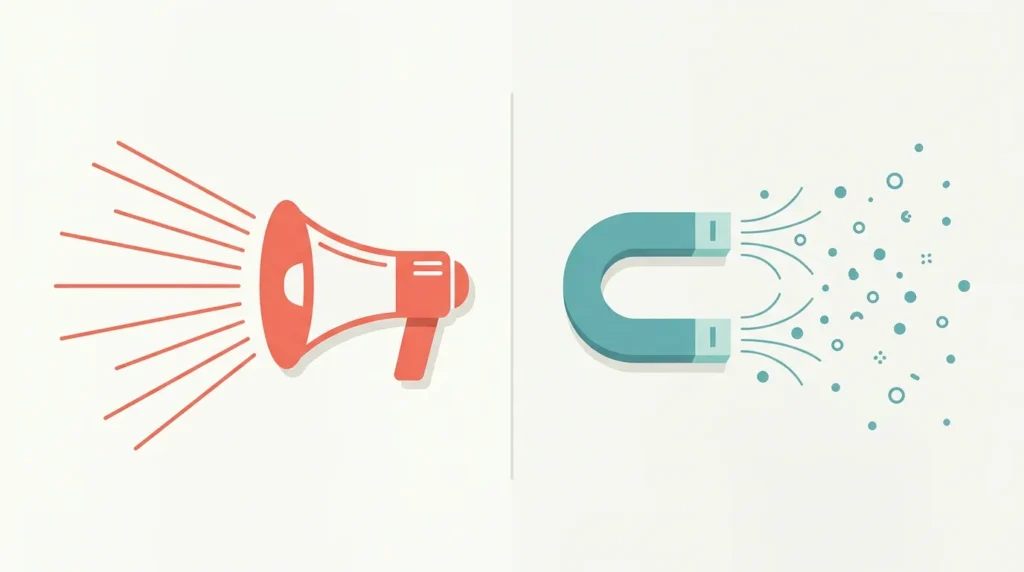
The difference between inbound and outbound marketing is mainly about who initiates the first contact. With inbound marketing, you help potential customers find your business when they are looking for information themselves. With outbound marketing, you actively approach audiences with a message or offer. Both approaches can contribute to online sales, but they require a different timing, investment and way of measuring.
The practical choice is rarely inbound or outbound. We would rather look at your target audience, your commercial goal and how much time you have to see results. Below, you’ll read how the two approaches differ, where they excel and how to combine them in a workable way.
Inbound marketing is an approach in which you offer relevant information and experiences to people who show interest themselves or are researching a question. Think of a clear service page, a practical article, a comparison guide or a useful email sequence. The goal is not simply more website traffic. You want the right visitor to take the next step, for example submit a request, book a call or complete a purchase.
Search engine optimisation (SEO) can help make your pages findable for relevant search queries. Content marketing then helps inform those visitors properly. A strong page connects the visitor’s question with a logical action. Does someone need information about a business website? Then a relevant next step could be to read about B2B web development: websites that drive business growth.
Inbound often works best when potential customers research online before they get in touch. That means you build trust step by step. It takes work: you need to know which questions your audience asks, create content that truly answers them and keep your pages up to date. Publishing just for the sake of publishing is not a strategy. Google Search Console guidance also emphasises the importance of useful, reliable content made for people, not just to attract search traffic. (developers.google.com)
Note the distinction: a visit, click, impression or email open is not yet a lead. A lead is a person or business with possible genuine commercial interest, where you typically have obtained contact details or a concrete request.
In outbound marketing, your company takes the initiative to bring an offer to attention. Online examples include targeted paid ads, business email outreach and campaigns based on a defined audience. So you do not wait solely for someone to find you through a search or article.
Outbound can be suitable when you want to reach a specific audience quickly, introduce a new service or bring an offer to the attention of people who may not yet be actively searching. That does not mean you should just approach as many people as possible. A broad campaign with a vague message mainly buys reach. Reach can be useful, but it is not a sales opportunity in itself.
So start with a clear goal and a carefully chosen audience. Determine who is likely to benefit from your offer, which problem you solve and which next step is appropriate. In paid ads, search intent, ad copy and landing page form one whole. Read for example about Search Engine Advertising (SEA): setting up and optimising campaigns to see how ad choices and the experience after the click belong together.
The core difference is who takes the first step. Inbound attracts interest through useful information and discoverability. Outbound brings a message actively to a selected audience. In execution there are more differences, but neither is automatically cheap, fast or effective. That depends on your audience, offer, competitive pressure, execution and follow-up.
A simple comparison can help, but the customer journey is not always neatly split in two. Someone may see an ad, read an informative article later and only then get in touch weeks afterwards. If you attribute all value to the last touchpoint, you may miss earlier influence. So measure as well as you can which channels contribute, and be honest about what your data does and does not show.
Choose inbound if your audience actively researches questions and your business has the expertise to provide useful answers. It is also a logical foundation when your website plays an important role in orientation or when you want to work structurally on organic discoverability.
Inbound requires patience. A good article or an improved landing page will not automatically generate requests. The content must match a real search query, the page must function well and the next step must be clear. An SEO optimisation approach can give structure to this work: SEO optimisation: a complete approach. Do not see SEO as a promise about positions, but as work on discoverability, content and usability.
Your website plays a commercial role here. If visitors do not understand what you offer, who it is suitable for and what they can do next, extra traffic cannot solve the underlying problem. For businesses that want to review their online foundation, this article on websites for business growth is a fitting deep dive. The choice between building it yourself and getting outside help can also affect planning and management. For that, read hiring a freelance web developer: benefits and pitfalls.
Outbound is worth considering when you want to reach a specific group, test a campaign quickly or put a new offer on the map. It can also help when there is still little question-related content to be found organically. But do not jump straight from “we have budget” to “let’s switch on ads”. First check whether your offer, audience, message and landing page all fit together.
For a new service, for example, you can run a limited campaign aimed at a narrowly defined audience. Then measure not only clicks, but also how many requests come in, whether they match your commercial criteria and how many conversations follow from them. If requests turn out not to be relevant, first investigate targeting, message and page. More budget on the same unclear campaign is usually not a diagnosis.
Outbound is also only responsible when your approach is relevant and professional. Use correct audience selection, a clear sender and an appropriate way to respect contact preferences. The exact rules for privacy and electronic communication can depend on your situation and market. So assess them carefully before running a campaign.
Inbound and outbound can reinforce each other. Outbound can bring a relevant message to a selected audience. Inbound can then help that audience better understand your offer, answer questions and build trust. Conversely, insights from content and search queries can help make outbound messages more specific.
Suppose you want to promote an online store with a new assortment. A targeted ad can lead interested people to a well-built product or category page. There, visitors then need to find clear product information, suitable choices and a simple ordering process. Thinking about a new online store or a major redesign? Then this guide on having a professional webshop made: costs and approach can help structure the preparation.
In business sales, the combination can look different. Informational pages support orientation, while targeted online outreach can start a conversation with relevant companies. Make sure marketing and sales use the same definitions. A lead is not yet a qualified sales opportunity. So distinguish between a regular request, a Marketing Qualified Lead (MQL), a Sales Qualified Lead (SQL), an appointment, a sales opportunity and a customer. That way, you avoid reports showing lots of activity while commercial progress remains unclear.
For more on choosing the right combination, read inbound and outbound marketing: how to choose the right mix. If you want to understand the choice at a high level first, also see the difference between inbound and outbound: what works for you? and when to choose inbound or outbound.
Start with one commercial goal. That could be, for example: more suitable requests for a specific service. Then choose a Key Performance Indicator (KPI) that is close to that goal. Website traffic, impressions and clicks are useful for understanding behaviour, but on their own they are not leads and do not automatically say anything about sales quality.
Create a simple measurement chain: campaign or page, visit, relevant action, request, qualification, appointment and possible sale. Use a Customer Relationship Management system (CRM) to clearly record requests and follow-up. Agree internally which information is needed to classify a request as a Marketing Qualified Lead or Sales Qualified Lead. Keep the definitions consistent, otherwise your reporting compares apples with forms.
Review the figures regularly and ask focused questions. Are the requests coming from the right audience? Which page or campaign contributes to a relevant next step? Where do interested people drop off? Are sales colleagues involved on time? Low conversion may point to the wrong message, an unclear page, a form that is too complicated or a mismatch in the audience. The data shows a pattern, but it does not always explain the cause itself. Combine figures with conversations and check the measurement setup.
If you are considering outside support, first make clear which problem that party should solve and how you will assess the collaboration. The guide choosing a marketing agency: services and selection criteria can help with that decision. For content-focused SEO support, you’ll find practical points in SEO advice: when and why to outsource SEO.
Inbound marketing helps potential customers find you and support their choice. Outbound marketing actively brings your message to a selected audience. Inbound usually requires consistent content and maintenance; outbound requires careful targeting, a relevant message and campaign management. Both can be valuable, and both can waste money or time if they are disconnected from your offer and sales process.
So do not start by asking which channel is popular. Start with your audience, their buying process and the commercial step you want to support. Then choose a suitable approach, measure relevant requests and improve what the data and conversations teach you. That is a lot less spectacular than a miracle cure, but usually a better foundation for a mature marketing plan.
Book a free strategy call and discover how many leads we can generate for your business. No obligations — just a concrete growth plan.
Book your free strategy call → Book your free strategy call — 30 min, no strings attached