
 Written by
Daniel van Hek
Search Clicks·September 18, 2026
11 min read
Written by
Daniel van Hek
Search Clicks·September 18, 2026
11 min read
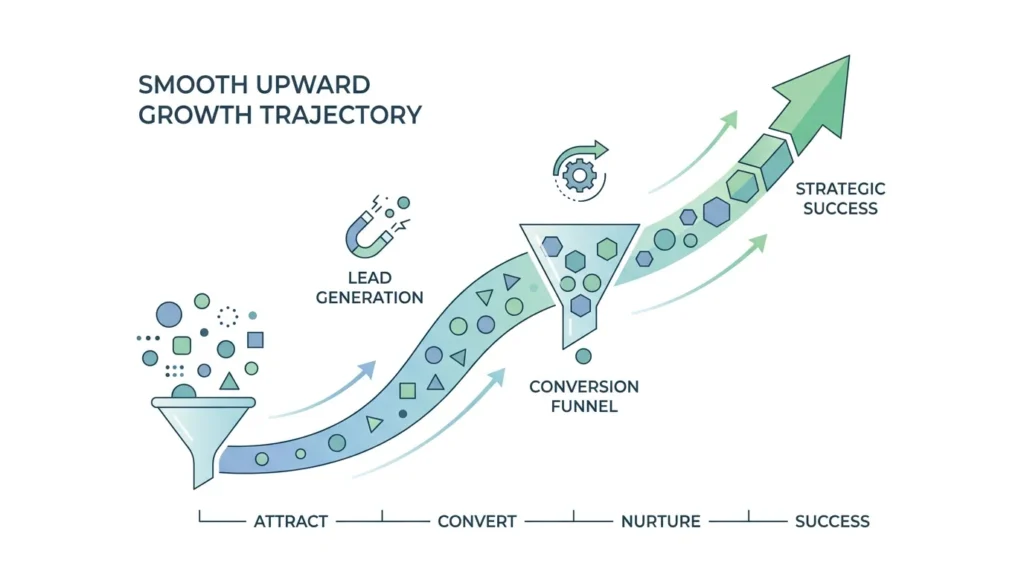
You want to generate more leads. Not more “traffic”, not more followers, and not more beautifully worded reports either. Leads. People or businesses that may genuinely be interested, and that you then follow up on smartly.
In practice, I often see the same pattern: the foundation is there, but capacity is leaking away. Or you do get clicks, but too few real completed enquiries. Or you have lead forms, but they’re too generic. Or you run campaigns, but you’re steering on the wrong KPI (Key Performance Indicator). The solution is usually not a completely new plan. It is better execution in the places where the conversation between visitor and buyer breaks down.
Below, you’ll get 12 tactics that we use in practice to win volume faster, without turning your whole marketing upside down. Short steps, clear choices, and measurable results. (No magic statistics. Just an approach you can test and improve.)
Before we fine-tune tactics, we need to be clear about one thing: what do you call a lead? A completed form? An appointment that’s actually scheduled? An enquiry that meets minimum requirements? This is crucial, because otherwise you optimise for behaviour that looks like intent, but isn’t.
Use a simple qualification structure:
This helps because “generating more leads” then doesn’t automatically mean “more work for sales that isn’t needed”. You can also improve marketing or sales in a targeted way, depending on where the friction is.
For SEO, in Google Search Console you can mainly steer on clicks, impressions and CTR (Click-Through Rate). Search Console explains how impressions and clicks are counted in the Performance report. (support.google.com) You use that data to see where you’re leaving opportunities on the table.
For conversions in web analytics, the rule is: in Google Analytics 4 it’s about events and so-called key events (previously conversions in other terminology). (support.google.com) The point is not the naming. The point is that you define one key event that matches a real step towards a lead, and only then expand from there.
You can improve nine landing pages, but if your offer doesn’t match what your audience wants, conversion will stay low. “You can’t persuade your way out of poor targeting.” A bit of a dry truth, but functional nonetheless.
A useful ICP contains at least:
You use this to align your page, your form, your follow-up and your messaging to the same intent.
Try landing on one of these formats:
The goal is for people to recognise faster: “This is for me.” That increases your conversion without you having to rebuild your entire funnel right away.
Many teams improve their ad copy and leave the landing page behind. That’s a shame. The landing page is where intent has to turn into action.
Use this checklist, and test one change at a time:
You don’t have to guess. You can A/B test copy, order and form length. And if A/B testing isn’t possible yet, make multivariate choices in small steps.
Yes, clicks and CTR help. But your goal is leads. In Search Console you can see how your site appears and how often you get clicked, with CTR and other performance data. (support.google.com) From there you can prioritise: which search terms get lots of visibility, but little action? That’s often where the copy and landing page work is.
Alright, now for the practical part. Below are 12 tactics in logical order. Start with the quick wins, but check your measurement right away, so you’re not optimising “blind” later on.
TOFU (Top of the Funnel) is about informing. MOFU (Middle of the Funnel) is about comparing or going deeper. BOFU (Bottom of the Funnel) is about deciding. If everyone always lands on the same page, intent gets lost.
Work with content that matches the exact question people are already asking.
More often than not: your form is too long for the amount of intent coming in. Split the form into:
Anything that isn’t needed to decide immediately whether something can become an MQL can come later. (You can do extra qualification in the intake.)
“Schedule a call” doesn’t always work. Sometimes people first want to know what it costs, what the lead time is, or what the process actually feels like.
Test one version with a concrete outcome:
It’s about clarity, not creativity.
If your form loads, your intent leaves. Fast quick wins:
This isn’t sexy optimisation. But it’s often the cheapest gain per lead.
Here’s how to work smart:
Search Console helps you understand clicks, impressions and CTR within Google Search. (support.google.com) That way you avoid doing organic work where there is little demand.
SEA (Search Engine Advertising) works best when you define one lead goal per ad group. Think:
If you send broad keywords to a generic page, you get leads with poor fit. That’s expensive, even if your CPC (Cost Per Click) looks low.
Lead generation doesn’t end when the form is submitted. In B2B, speed is often decisive. We often see that the same number of leads, with faster and better follow-up, leads to higher MQL and SQL numbers.
Specifically:
Automation is fine here, as long as a person takes over where needed. Don’t let software make budget or contract decisions on its own.
Many dashboards only show channel performance. But you want to know:
Use that to guide your budgets and content. Sometimes a channel with less volume turns out to generate more SQL. Then it isn’t a “failure”. Then it’s a different type of intent.
In Google Analytics 4 you work with events and can mark important events as key events. (developers.google.com) Make sure that:
Keep the measurement set limited. Rather measure one reliable step than five doubtful ones.
Many teams stop after a lead. But sometimes the real purchase comes later. Think about:
No spam. Just relevance. And you stop when someone shows interest or drops off.
If your conversion is low, it can be because of:
Do your research with a simple approach:
If you don’t break the funnel into pieces, you optimise blindly. That’s the marketing version of trying to find a leak in a ship by feel.
This is boring, but worth its weight in gold. Define the fields sales needs for a quick fit check. For example:
Then you can optimise marketing for real quality. And sales gets less junk.
You don’t just want to read, you want to move. So here’s a realistic order, suitable for companies that are already doing lead generation but want more volume.
If you do this consistently, you build a system. And then lead volume rises less erratically than when you start over every time.
If you want, you can also connect this to a broader setup. For example with this internal guide: Lead Generation: Complete Strategy for More Customers.
Generating more leads rarely comes down to one miracle tool. It comes down to three things you can control:
Take the quick wins this week: tighten your definitions, improve one landing page, and speed up the follow-up. Then iterate on the bottleneck you see in the data.
And remember: you don’t just want more leads. You want more valuable leads. That’s the real fastest route to sustainable growth.
Book a free strategy call and discover how many leads we can generate for your business. No obligations — just a concrete growth plan.
Book your free strategy call → Book your free strategy call — 30 min, no strings attached