
 Written by
Daniel van Hek
Search Clicks·September 18, 2026
12 min read
Written by
Daniel van Hek
Search Clicks·September 18, 2026
12 min read
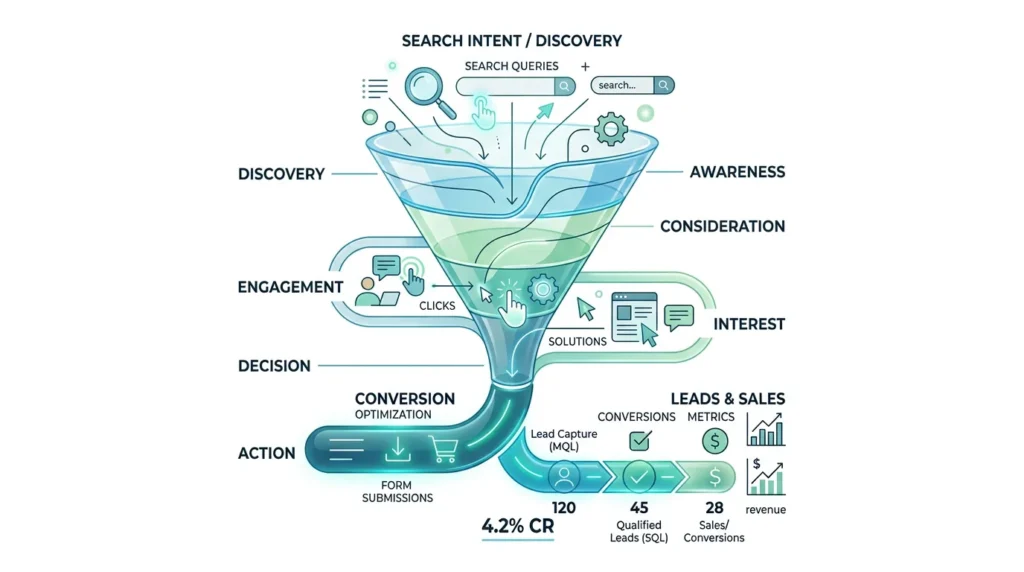
To play devil’s advocate for a moment: “sea sem” sounds like a bowl of alphabet soup. But if we unpack it properly, it usually comes down to one thing: online visibility and sales through search engines.
More specifically, we focus on Search Engine Advertising (SEA), which often means paid search campaigns. On top of that, we look at the broader approach of Search Engine Marketing (SEM). In SEM, you combine SEA with Search Engine Optimization (SEO), but also with conversion and measurement discipline. Because if you don’t measure, you’re just spending based on hope.
In this article, we take “sea sem” in a practical way for businesses that want traffic not only to click, but also to generate leads. We focus on what works, why it works, and your next step, without sales fluff.
You can see SEA and SEM as a chain. If one link is weak, the rest of the chain pays the bill.
What matters here for quality is that in SEA, a search engine looks not only at your bid, but also at the quality of your ad and the experience on your landing page. Google describes the so-called Quality Score as consisting of components such as ad relevance, expected click-through rate and landing page experience. (support.google.com)
That is not academic theory. In practice, it means this: if you create an ad that “matches the search term,” but your landing page navigates like a maze, your efficiency drops. Then you pay more per click, and you lose conversions on the page. A double shame.
If you recognise this in your setup, the solution is rarely “more budget.” It is usually better matching and better measurement.
All right, let’s make it concrete. For SEA within sea sem, you can see campaign structure as your intent map. Your goal is for every group of search queries to land logically on a landing page that fits that intent.
Instead of looking only at keywords, look at intent layers. For example: “informational” versus “ready to buy.” And within ready to buy: “quote,” “price,” “compare,” “delivery,” or “implementation.”
In practice: you build ad groups around one dominant use case. Then you build landing pages per use case, or at least create clear sections on each page that quickly point visitors to the right route.
Google supports the view that landing page navigation and landing page experience affect ad quality. (blog.google)
So make sure your ad and your landing page start with exactly the same “promise.” Not literally the same sentence everywhere, but the same value proposition, the same audience language, and the same next step.
Your campaign collects data through Search terms. From that, you can get information to:
In SEA, this is often the “boring” work. And that is exactly why the return gets better. Boring is not glamorous, but it works.
Budget is a lever. But only if you know where inefficiency sits. Google Ads also has a system of recommendations and optimisation, and those recommendations are described as personalised suggestions. (business.google.com)
Our way of making this practical:
If you want a more hands-on look at how to keep budget and control tight, this link fits well in your playbook: Sea budget: this is how you keep your Search campaigns tight.
SEM does not just mean “running paid ads.” It means managing the search landscape as a whole.
Your advantage in sea sem is that you can use data from SEA for SEO, and vice versa. For example: search terms that generate many high-quality enquiries in SEA become content briefs for SEO pages. And SEO pages that rank well but generate few enquiries become input for landing page tests.
If you use SEA and SEO without sharp measurement, team discussion gets messy fast. The numbers start to differ, and everyone thinks the other person is “reading it wrong.”
For example, you have multiple sources:
It is also important to understand that GSC and GA4 do not measure exactly the same scope, and differences can appear in comparisons. Google Search Central indicates that there are differences in what is reported, for example around canonical URLs versus URLs with tracking code. (developers.google.com)
So: create one internal KPI definition and one measurement regime. Otherwise, you lose time in reporting politics.
We often work with a funnel structure, but without jargon if the visitor doesn’t benefit from it. You can explain it like this:
SEA is usually aimed more quickly at MOFU and BOFU. You can build SEO for TOFU and MOFU, and then link the best-performing pages to lead conversion.
This is the part where many teams are “almost done.” The campaigns are running, CTR looks fine, but the leads don’t come in. Often the landing page is the bottleneck.
Google specifically discusses that landing page navigation can play a role in the ad quality systems for search ads. (blog.google)
For sea sem, you need tracking that fits your sales process. The minimum setup is:
Important: by lead here we mean a person or company with potential commercial interest, not “someone who viewed a page.” That may be useful as data internally, but in lead reporting you really need requests or contact details.
Optimisation is not a one-off task. It is a rhythm. We usually work in cycles of two types of changes:
If you want to go deeper on this topic, this is a useful internal reading path: Sea optimisation: from clicks to measurable leads.
In sea sem, it is not only about more leads. It is about quality leads. We often see teams push for scale with a low conversion chance, and then CPL may look “lower,” but Sales Qualified Leads fall. That is not profit; that is a cost shift.
Trade-off: if you make your filter too strict, you get less volume. That’s fine. Then you gain time and budget, as long as your sales process can handle it.
Sometimes we simply need extra capacity. Or a team that tests and analyses faster. But you should not outsource because it “sounds convenient.” You do it because it helps you steer better on CPL and SQL.
Here are two realistic ways to approach this:
If you want to explore this topic in a concrete way, these links fit the decision process:
And if you want to define which online marketing support you need at all, this page often helps you ask the right questions: Online Marketing Agency: Services, Benefits and Selection Guide.
Take 30 minutes and check this list:
If one of those answers is “no,” then your next step is simple. First fix the measurement point or the message, and only then “optimise the campaign.”
Here is an approach you can start tomorrow. No big ceremony, just clear actions.
Goal of week 1: your reporting must be “true,” not “pretty.”
Goal of week 2: less waste, more enquiries per click.
Goal of week 3: more relevant traffic. And more relevant traffic is often cheaper over time.
Goal of week 4: a system that improves itself.
If we summarise this, sea sem comes down to three things you can control.
If you must make one choice now: start with measurement and message match. Only then move on to structural optimisation and budget shifts. That is usually the fastest route to more high-quality enquiries, without your team needing to “brainstorm” for a week.
If you want extra depth, you can use this content as a supplement to your internal training:
And yes, it sounds almost too simple to be true. But in online marketing, “simple and consistent” is often the difference between making plans and selling.
Book a free strategy call and discover how many leads we can generate for your business. No obligations — just a concrete growth plan.
Book your free strategy call → Book your free strategy call — 30 min, no strings attached