

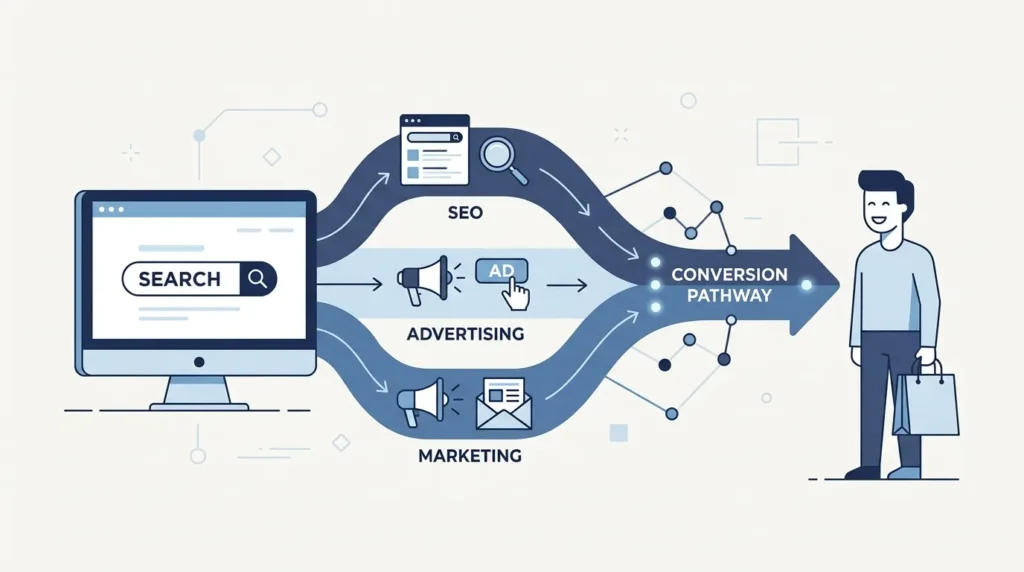
Let’s grab a coffee, because we’re going to make this concrete. The terms SEO, SEA and SEM are often used interchangeably. What you probably want is one thing: more relevant enquiries and sales from search. Not more numbers just because they look nice.
In this article, we tackle “seo sea sem” as one system. We’ll show how to use them together, what you need to capture in your measurement setup, why certain levers really matter, and what your next step is. No vague promises. Just a workable plan.
What SEO, SEA and SEM mean, and why they work better together
Start with the definitions, otherwise we’ll be talking past each other:
- SEO means Search Engine Optimization.
- SEA means Search Engine Advertising.
- SEM means Search Engine Marketing. In practice, SEM is often an umbrella term that brings SEO and SEA together in one marketing strategy.
Why is “seo sea sem” such a logical approach?
- SEO builds lasting visibility. It works later, but can keep delivering over the long term.
- SEA brings in immediate demand. You can test and adjust faster.
- SEM focuses on total results. It prevents SEO and SEA from accidentally working against each other, for example by double-counting the same conversion goals or piling traffic onto the same pages without improving them.
Our experience from real-world projects: the biggest return usually does not come from “more traffic”, but from better matching between search intent, ad copy, landing page and measurement plan. That is where SEO, SEA and SEM reinforce each other.
Strategy: start with intent, not keywords or budget
If you start with keywords and campaigns alone, you often miss the real question: what does someone actually want to do at that moment? Search intent determines your:
- landing page structure
- CTA (Call to Action)
- form field set
- offer (what you give) and proof (why your promise is believable)
Step 1: build a short intent map
You do not need twenty segments. Start with three to five intent categories, for example:
- Research, the user is looking for information or comparing options.
- Problem and solution, the user wants to know how something works and which approach fits.
- Comparison, the user wants pricing, features or differences.
- Ready to book, the user is searching for “service + location”, “rate”, “plan”, “quote”.
For each intent, choose one main goal. In lead generation, we aim for real commercial interest, so a lead only counts as a lead once we have contact or a substantive enquiry (for example a form with company details, or an intake booked through an appointment). Website traffic alone is not a lead.
Step 2: choose KPIs by layer (TOFU, MOFU, BOFU)
We keep it simple:
- TOFU (Top of the Funnel): KPIs focused on relevance, not on “heavy” conversions that are not yet the right fit. Think engagement or page-level qualification (with policy, not guesswork).
- MOFU (Middle of the Funnel): KPIs focused on interest. Think scored forms or demo requests.
- BOFU (Bottom of the Funnel): KPIs focused on actual conversion, such as a quote request or appointment. Be careful with terms: conversion here means a specific, valuable action.
And yes, we use KPIs. But only KPIs you can act on. Otherwise it turns into dashboard theatre.
Tracking and measurement: this needs to be right before you optimize
Many teams optimize blindly. That is like tuning a car based on a mirror, without looking at how the steering behaves.
Google Search Console for SEO signals
In Google Search Console, the “Performance report” is your foundation for SEO. It shows, among other things:
- Clicks
- Impressions
- CTR (Click-Through Rate)
- Average position
Google says the Performance report shows clicks and impressions, and by default also CTR and position. (support.google.com)
Practical interpretation:
- Rising impressions with a steady CTR often point to a copy and snippet problem.
- Stable impressions with falling CTR often point to a title or description that no longer fits.
- A drop in both CTR and position usually calls for content relevance and internal structure work.
Google Analytics 4 for conversion definitions
In Google Analytics 4, it’s all about events and key events (key events are the version of conversions used for valuable actions). Google explains that in GA4 you measure conversions via key events and can mark events as key events. (support.google.com)
Practically, this means:
- You define one or two “real” key events per intent.
- You avoid treating every click as a conversion.
- You check whether the key event data matches what Sales sees in CRM follow-up.
Google Ads for CPA and cost-aware optimization
In SEA and in SEM, you need conversion tracking, otherwise you are steering by feel. Google defines CPA (Cost Per Action, or Cost Per Acquisition in many marketing contexts) as the average amount you pay per conversion. (support.google.com)
Trade-off to keep in mind:
- If you optimize too early for “heavy” conversions, algorithms learn slowly because the data is sparse.
- If you optimize too early for “light” actions, you get traffic that does not convert into real enquiries.
Our rule: start with a measurement plan that matches qualification. So not just “form submit”, but for example “form submitted with minimum fields” or “appointment booked”.
If you want to take tracking seriously, you can also read how we support SEA optimization with measurable leads: Sea optimization: from clicks to measurable leads.
Bringing SEA and SEO together: a workable seo sea sem system
Now for the fun part. You are not choosing between SEO and SEA. You are orchestrating them.
1) Use SEA to test fast, SEO to scale
SEA is your test lab. You can quickly run variations in:
- search terms and ad variants
- landing page setup
- CTA and proof blocks
What you then transfer to SEO is not just “keywords”. You transfer:
- the message that earns the right click
- the structure that helps people move through the page
- the intent your content is truly aimed at
Want a more hands-on way to start with Search campaigns right away? This fits that approach well: Google Ads SEA: How to set up Search campaigns properly.
2) Build one conversion flow that works for both channels
SEO and SEA deserve the same landing page logic, but not the same ad copy. Why?
- SEA needs to persuade faster, because you start with paid attention.
- SEO can provide a bit more context, because you often get a different type of user who is searching more deeply.
That is why we build a “conversion flow” with:
- one clear promise above the fold
- proof blocks that fit the intent
- a form or appointment module with minimal friction
- a confirmation screen or follow-up communication that helps Sales
And because you probably want measurable improvement too, it helps to connect SEO to measurable leads: Seo online: from visibility to measurable leads.
3) Allocate budget smartly within SEM, not based on noise
SEM is your total search marketing mix. So your budget split is not “SEO gets X, SEA gets Y”. It is:
- where can we deliver immediate value through SEA
- which SEO pages are almost ready to scale
- which intents still lack strong landing logic
Practically, this comes down to a monthly cycle:
- Analyse search queries, CTR trends and page performance (Search Console for SEO signals).
- Check in SEA which searches lead to a strong conversion flow.
- Make changes to landing pages and ad copy that match intent.
- Reallocate budget where CPA is genuinely within range.
What works in practice: 7 tactics that work for seo sea sem
I’m not giving you a magic list. Just tactics that we see work again and again when teams execute them properly.
1) Match search term to intent, not just to keyword
Keyword targeting is a start. But your ads and pages need to answer the question behind the search term. That is how you improve CTR and CVR (Conversion Rate) at the same time, without “clickbait”.
2) Use Search Console to capture snippet opportunities
If impressions rise but CTR does not move with them, it is often a title or description problem. Then you can increase snippet relevance with content and internal focus. The Performance report gives you exactly the core metrics to spot that. (support.google.com)
3) Make ad copy shorter and more specific
Short is not enough, specific is better. Use one primary value and one proof detail. The rest can wait. SEA has less patience, SEO has more context. But both want clarity.
4) Landing pages should do one job
If a page is trying to be “explanation”, “comparison” and “quote request” all at once, it usually goes wrong. For each intent category, we choose one main task:
- research, focus on explanation and approach
- comparison, focus on differences and decision support
- ready to book, focus on speed, process and appointment
5) Test form friction, not just traffic
A click that costs more can still be profitable if your form friction is low and Sales follows up quickly. In other words, optimize your response and CRM follow-up too.
Want extra sharpness for Search campaigns? Read: Sea Google Ads: How to make Search campaigns sharper.
6) Set up a conversion hierarchy (primary and secondary)
Your primary conversion is the action that truly represents value. But you can use secondary actions to learn faster, as long as they are genuinely predictive.
Google explains in GA4 that you can use key events as conversion measurement, so you measure what matters to you. (support.google.com)
7) Combine with outbound where demand is slow
Sometimes SEO and SEA are not enough for fast lead generation, especially in more complex B2B markets. Then we connect search intent to proactive outreach. Think of using outbound marketing to convert people who are already showing interest more quickly.
If you want to see what that looks like in practice: Outbound Marketing: Proactively Reaching Out to Customers.
Next step: how to tackle seo sea sem in 14 days
Let’s make a plan. Not a nine-month project.
Days 1 to 3: get measurement and definitions in order
- Define 1 primary conversion (CPA or Cost Per Acquisition, if that is your goal, through your agreed action) and 1 secondary conversion.
- Check your GA4 key events setup and mark the right events as key events. (support.google.com)
- Check Search Console Performance report metrics for SEO signals, with CTR and position as the starting point. (support.google.com)
Days 4 to 7: align landing pages and ad messaging with intent
- Choose one landing page variant per intent category.
- Write one ad variant per intent with one promise and one proof detail.
- Remove noise from the page. One task, one CTA.
Days 8 to 11: test SEA, adjust SEO for snippets and internal structure
- Run SEA tests on searches that are likely to fit your intent map.
- Use Search Console to select pages where impressions are high but CTR is lagging. (support.google.com)
Days 12 to 14: decide, don’t keep tweaking and hoping
- Stop what does not contribute to primary conversion, not just CTR.
- Scale what does convert. Only then increase budget or deepen SEO content around that intent.
- Make a list of SEO topics that come from SEA learnings (message and structure, not just terms).
And if you also want to look at AI search results and how they affect your search strategy, then this article fits: Generative Engine Optimization (GEO): AI Search Results.
Common seo sea sem mistakes, and how to avoid them
- Mistake 1: You treat traffic as a lead. No, a lead only counts as a lead if there is a real commercial enquiry with enough contact or context.
- Mistake 2: You optimize for the wrong conversion. If your secondary actions are not true predictors, your KPIs get polluted.
- Mistake 3: You copy SEO text into SEA without adapting it. Ads need to be faster and more concrete.
- Mistake 4: You forget CRM follow-up. Even with good CVR, the pipeline can become the bottleneck.
- Mistake 5: You use too many KPIs at once. One page, one goal and one measurement plan are often better than five dashboards.
By the way, if you work in B2B or B2C, the conversion flow is different. For B2C, this can help: Lead Generation B2C: Converting Consumers, Step by Step. For B2B, this: Lead Generation B2B: Attracting Business Customers, Brief.
Where automation makes sense in seo sea sem, and where it doesn’t
Automation is not a goal in itself. It is a way to save time and increase consistency in lead generation and sales optimization. That is why we mainly use it for:
- lead capture and data synchronisation to CRM
- lead qualification based on form context
- automated follow-up that eases the load on Sales, without being inappropriate
- campaign reporting and quick detection of anomalies
Important: automated systems should not make budget or contract decisions without human approval. We always keep a human in the process for high-impact decisions.
If you are specifically looking at connecting AI and systems for marketing, sales and lead generation, then this is a relevant deep dive: API OpenAI for marketing, sales and lead generation.
Conclusion: seo sea sem is an orchestra, not a competition
If you approach “seo sea sem” properly, you build one search strategy where SEO and SEA strengthen each other within a SEM framework. You start with intent, you measure the right actions, and you optimize for the conversion flow, not for isolated clicks.
Our suggested next step is simple: fix your measurement plan within 14 days, connect ad to landing page by intent, and start SEA tests on the right demand. After that, refine SEO with real learnings from what is already working.
And if you notice the numbers are not moving, then at least we know it is not a marketing mystery. Then it is a measurement problem, a page problem or a follow-up problem. Coffee on, and let’s fix it.
