
 Written by
Daniel van Hek
Search Clicks·September 28, 2026
13 min read
Written by
Daniel van Hek
Search Clicks·September 28, 2026
13 min read
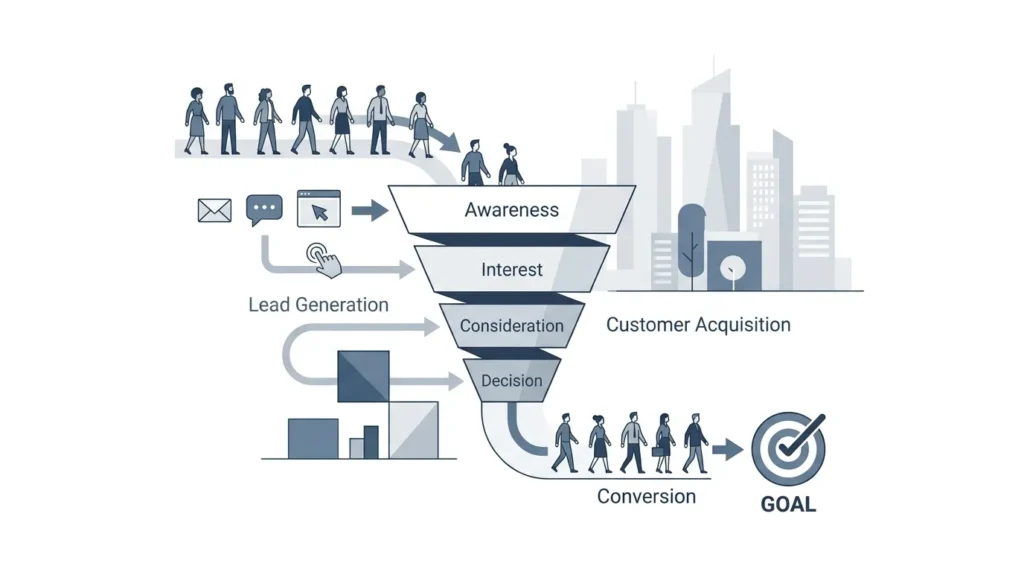
Imagine lead generation as a funnel with one big pitfall. You only see the top, so you keep focusing on more traffic, more sign-ups and more form submissions. Sounds familiar. And it feels efficient too, until your pipeline does not move with it.
That is why we take a different approach. Not “more leads”, but more relevant leads. And above all: more leads that naturally move on to a Sales Qualified Lead (SQL). This article gives you a complete, workable strategy. From first interest to conversion, including what to measure, how to qualify and how to set up nurturing. No magic tricks. Just a system.
First let us get clear on what you are trying to achieve with lead generation. In online marketing and online sales, a “lead” is only a lead once someone shows real commercial interest and you have their contact details or a concrete request. So: not just clicks, not just website visits, and not just social engagement. You need a real signal.
Use a fixed language within your team. That prevents discussion later, especially in reporting.
Why is this important? Because otherwise you optimise for the wrong KPI. And then it looks like your campaigns are not working, while you are only optimising the wrong metric.
We see it in practice time and again: more requests is possible, but if sales cannot work with them, your total cycle time drops. You get a higher workload, lower response and more no-shows. That hurts downstream conversion.
The solution is simple, but not always comfortable. You build a system that filters early. Not through randomness, but through better input, better questions and better follow-up.
We want your lead generation to be more than a set of separate actions. You need a rhythm. Think in phases, and for each phase define a separate goal, message and measurement plan.
You can split this into Top of the Funnel (TOFU), Middle of the Funnel (MOFU) and Bottom of the Funnel (BOFU).
In practical terms, this means your message changes by phase. Your landing page changes too. And your CTA (Call to Action) is different in every phase.
Lead generation is channel-independent. It is about the combination of offer, targeting, landing page, form and follow-up.
Many teams think traffic is the bottleneck. Often it is not. Often the landing page is the bottleneck. Then it is about match, friction and one clear action.
A practical CRO approach is: set one primary goal action, make the promise consistent with your ad or search intent, and reduce form friction without giving away qualification. In CRO analyses this concept is often summarised as “reduce friction, keep a single goal, improve message match”.
You do not need to guess. You can test and improve your approach with a fixed CRO routine.
When your lead generation is mature, your tracking is too. Otherwise you are steering by gut feeling. And yes, we see that happen. Then optimisation becomes a hobby instead of a decision process.
In practice, we use a set of conversions that cover multiple levels. You want at least:
In Search Engine Advertising and offline conversions, you can use “qualified leads” and “converted leads” to include offline qualification steps. Google explains in its Ads documentation that you can import offline conversion data and that “qualified leads” follow the trail of Google-generated leads that are further qualified offline, for example via CRM. (support.google.com)
In Google Analytics 4 (GA4), much of your measurement quality depends on properly configured events and conversions. GA4 focuses on events and publishes recommended event concepts, and there are migration and setup paths that help you structure your measurement foundation. (support.google.com)
Our rule of thumb: first define your funnel events in business language (lead, qualified, appointment), then translate that into events. Otherwise you create dashboards that are technically correct, but commercially useless.
A form is not just a data point. It is a filter. And filtering is good, as long as your goal is clear: fewer unsuitable submissions and faster follow-up.
Example, without marketing poetry: ask one or two questions that refine your ICP, such as industry, budget range or use-case type. Then route leads automatically to the right follow-up flow.
In Google Ads documentation you also see mechanisms for “qualified responses” in lead forms, where your follow-up goal is automatically linked to a “qualified lead goal”. (support.google.com)
Now it gets practical. You cannot do everything at once. You choose a mix based on your sales cycle, average deal size, lead time and sales capacity.
SEO is often your long-term volume. SEA is your short-term fuel. The trick is to build SEA campaigns with landing pages that fit your qualification step, and not to let SEA budget keep buying “leads” without limits.
A handy route to more structure is: Generate online leads: strategy and system that works. Use this as a template for your own funnel.
You often see CTR in reports. It is useful, but it does not tell you whether your lead generation works. For lead generation, KPIs like CPL (Cost Per Lead) and especially lead quality matter. CPA can also be relevant, but pay attention to which definition you use: CPA as Cost Per Acquisition or CPA as Cost Per Action. For lead generation, you usually choose an action that sits close to commercial intent, for example “appointment booked” or “SQL accepted”.
If your costs rise but your SQL volume rises too, that is a good trade-off. If your CPL drops but SQL drops hard, then your marketing is buying forms, not pipeline.
If you want to figure out where your budget realistically lands, this article helps: Google Ads Costs: What Do You Really Pay?.
B2B lead generation often revolves around more complex decisions. That is why we build a model that takes multiple stakeholders and a longer consideration period into account.
A good foundation for B2B structure can be found here: B2B lead generation: plan, channels and conversion to SQL.
What usually works well in B2B:
In B2C, the threshold is often lower. That makes it easier to get leads, but it also makes it easier to collect the wrong leads. Then your marketing is still left with low show rates or low conversion to customer.
For an approach that is often directly applicable: Generating B2C leads: proven online strategies.
What we often see as a “win” in B2C:
Outbound is not an emergency measure. It is a channel. But you need to use it smartly. If your list quality is off or your message does not match, you get irritation and little response. Then it remains an expensive pitch.
If you want to weigh whether outsourcing cold acquisition makes sense for you, read: Outsource Cold Acquisition: Is It Worth the Investment?.
And for execution, with attention to timing, deliverability and follow-up, this is a helpful starting point: Cold Mailing: Effective Email Acquisition (2026).
Nurturing is not “an autoresponder”. It is a controlled move from lead to appointment or to a sales conversation. You steer content-wise toward the next threshold.
A practical approach to planning and execution: Mailing Campaign: planning and execution for results.
In your nurturing we mainly look at:
If you buy or generate traffic through SEO, you want it to flow through to SQL. That requires consistency between ad, landing page, form, routing and sales follow-up.
Here is a route we often use as a complete framework: Online lead generation: from traffic to SQL with a system.
Automation can make your lead generation faster and more consistent. But only if automation supports your measurable goals. We do not automate “because we can”. We automate to:
A good automation rule is: let software do execution tasks, and let people decide where impact is high.
Examples of “safe” automation:
Examples of “not without human approval”:
When we use AI, it is to optimise marketing and sales processes. Think of rewriting variants for landing pages, summarising intake questions, or helping to draft follow-up copy. That always stays under human supervision, especially where compliance, brand tone and commercial claims come into play.
A lead process is something you can repeat. Campaigns are what you run temporarily. When your team members work around a lead process, execution becomes predictable.
It also helps to assign role and responsibility. If you want to improve your SEA or search ads approach structurally, this article can serve as a practical checklist: Google Adwords Specialist: tasks, approach and checklist.
Okay, we have covered strategy. Now make it concrete. Here is a realistic route we often use to move teams quickly from “we are trying things” to “we are steering on results”.
Lead generation is not about collecting as many touchpoints as possible. It is about a controlled move from interest to SQL. That requires clear definitions, landing pages that convert, qualification that reduces friction for the right people, and tracking that helps you steer on the real bottleneck.
If you take away one thing, make it this: optimise downstream. If your marketing delivers leads that sales cannot convert, you lose value, no matter how good your dashboards look.
Take the 14-day route. Get your measurement and routing right. And once that is in place, lead generation becomes a repeatable process. And honestly, that is the only “quick win” we trust.
Book a free strategy call and discover how many leads we can generate for your business. No obligations — just a concrete growth plan.
Book your free strategy call → Book your free strategy call — 30 min, no strings attached