
 Written by
Daniel van Hek
Search Clicks·October 3, 2026
12 min read
Written by
Daniel van Hek
Search Clicks·October 3, 2026
12 min read
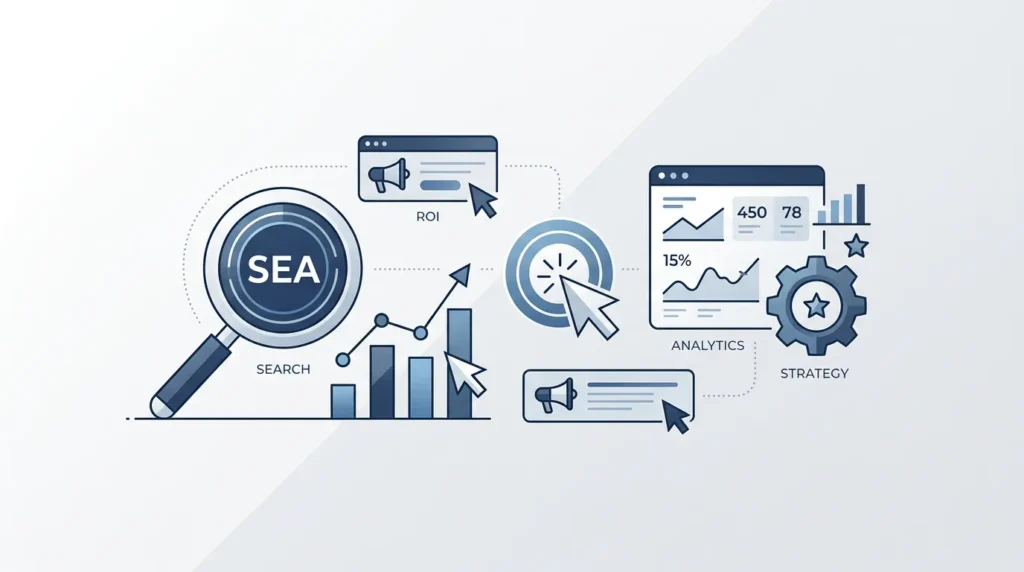
Picture this for a moment: you launch a campaign, your budget is running, and you think, “Great, we’re getting clicks.” And then comes the real question: are we getting real enquiries (or better yet, Sales Qualified Leads), at a cost per lead that makes sense? That is exactly where a sea marketing bureau makes the difference.
In this article, we’re not talking about vague promises. We make the choice for a SEA marketing agency concrete. We explain which approach works, why it works, which trade-offs you have to accept, and what your next step is. So yes, this is going to be practical. Grab your coffee, we’re going to look at what you need to pay attention to.
A SEA marketing agency (Search Engine Advertising) focuses on paid ads in search engines. Most of the time, that means Google Ads and sometimes additional search channels. The core is simple: we buy intent. People search, so we get to be relevant to that.
But “relevant” is not a feeling. It is measurable behaviour:
If you choose a SEA marketing agency, you want someone who can handle this end to end, or at least work tightly with your web team and sales team. Because SEA without landing page and measurement quality is like a steering wheel without a road. You can turn it, but you won’t get to your destination.
The agencies I trust most stand out by their structure. Not because they make beautiful decks, but because they keep asking the same questions consistently:
Watch out: an agency that mainly says “we optimise campaigns” but does not talk about tracking and landing page experience is often not ready for real profit optimisation.
In many SEA accounts, you work with Responsive Search Ads (RSAs). Google itself provides best practices for writing and structuring these ads, with the idea that using multiple assets can create more relevant combinations. (support.google.com)
What does that mean for you? Your agency should:
This is where it gets useful. Use this list as your conversation script. You are not looking for the “best agency”. You are looking for an agency that fits your product, sales cycle and data maturity.
This is the foundation. If your agency is not sharp on conversion tracking, you can optimise until the cows come home, but on the wrong KPI.
Ask specifically:
Google gives best practices around optimising ads and landing pages and explicitly refers to “ad relevance” and “landing page experience” as parts of Quality Score. (support.google.com)
Practical check: have them explain how they use Quality Score to prioritise improvements. If they only talk about budget, you are missing the lever.
SEA lands on web pages. So your landing page is your conversion machine. Google also explicitly states that landing page navigation and the experience on the landing page are relevant to the search ad experience. (blog.google)
So ask your agency:
Watch the trade-off: changing a landing page costs speed, but usually improves quality. Your agency needs to be willing to do it, not just “write copy”.
For RSAs, you want variation, but you also want clear intent. Google works with combinations of headlines and descriptions and provides guidelines for effective structure. (developers.google.com)
Ask: how do they stop RSA combinations that fit less well from still being shown? They do not need to control everything, but they do need to know how to steer using assets, structure and landing page alignment.
Good SEA optimisation has rhythm. Think weekly reviews, monthly adjustments and structural improvements to landing pages and tracking.
Concrete questions:
If an agency says they optimise “everything in real time” but you cannot hear a process, KPI and governance, then that is mostly marketing talk. (Nice for a website, less nice for your margin.)
A trustworthy agency names the trade-offs. For example:
You want an agency that explains that reality honestly, so you do not end up in a “let’s just wait a bit” trap.
Now for the practical part. If we hire a SEA marketing agency, you want a plan you can follow without drowning in technical details.
First the KPIs. In SEA, it often comes down to:
Why does this work? Because otherwise your optimisation is too much driven by click behaviour. And that is usually not the purchase intent you want.
Campaigns need to be built in a way that lets you make decisions. Not just “we have 10 campaigns”, but:
If you do this well, optimisation becomes easier. That is not a luxury, that is cost savings.
Google emphasises that choosing a landing page that matches your ads and keywords is important for ad relevance and landing page experience (part of Quality Score). (support.google.com)
In practice:
Do you want to roll this out more broadly? Then this internal link fits well: SEA Campaign Setup: Strategy to Execution (step by step).
If you run SEA, you need to measure. Not only in Google Ads. Also at site level. Google also documents how you can connect Search Console and Google Analytics data to monitor and debug more effectively. (developers.google.com)
What you notice in practice:
Watch the limitation: integrations help, but they do not fix bad tracking logic. That is why validation is part of the process, not a separate check afterwards.
Good optimisation is not endless. It is decision-driven. Your agency should approach tests with a hypothesis and a measurement plan. Think about:
Trade-off: if you change too much at once, you do not know what worked. You want rhythm, not chaos.
Many companies stop at “we’re getting enquiries.” But your question is probably sharper: are we getting the right type of enquiry, with a follow-up that does not disappear into an inbox?
That is where lead generation comes in. And yes, that touches SEA directly, because SEA delivers the first contact moments.
In B2B and B2C, the signals work differently, but the principle is the same. You want your funnel (TOFU, MOFU, BOFU) to match your campaigns, and you do not want to lump everything together.
A useful next step is to go deeper into lead generation for your situation. For example, if you work in B2C, read: Lead generation B2C: strategy, channels and measurable system.
If your site gets traffic, but you do not qualify well, then what you mostly get is “interest”. That can be marketing, not sales.
That is why your SEA landing page should not only convert to a form. It should convert to a lead you can qualify. Think about:
If you want to tackle this systematically based on your site, this link fits well: Lead generation site: from traffic to SQL with a system.
CTR (Click-Through Rate) is a signal for ad relevance. But your real steering happens on CVR and CPA. Google also links Quality Score to landing page experience and ad relevance. (support.google.com)
So yes, we look at CTR to learn. But we build a budget plan on conversion behaviour.
You do not have to choose between SEA and SEO. You can link them so that SEA shows you where SEO deserves priority, and SEO lowers your SEA costs by making you more relevant.
If your agency understands this, you get fewer “ad hoc” improvements. You get a combined plan in which content and landing pages strengthen each other.
In concrete terms:
Want to see this worked out further? Then this internal article fits well: Choosing an SEO agency: combine SEO and marketing smartly.
SEA is often faster for testing, SEO is often better for building over the long term. If you organise them separately, you work past each other. If you organise them together, you learn faster and your website foundation becomes smarter.
Limitations: this takes coordination. Your agency needs to align with your content, your dev team and your sales process. If that collaboration is not arranged, it stays theory.
If you have an agency conversation today, do the following. No huge commitment, but clear direction.
Ask them to deliver the following within a short period:
If they cannot do this, that is a signal. Not because it is impossible, but because you will probably get an agency that mainly executes instead of steering.
You want fixed moments where decisions get made. For example:
If you also want to look more broadly at online marketing roles and specialisations, you can use this link: Online Marketing Company: Services and Specialisations.
SEA is not a stand-alone task. It is about lead generation that turns into appointments and opportunities. If you want to learn how to build a system that also feeds your sales process, read: Generate sales leads: how to build a system that sells.
And if you need a complete strategy that shows up everywhere, this fits well: Lead generation: complete strategy for more customers.
A sea marketing bureau is only valuable if it does more than manage ads. It has to connect your SEA to a measurable lead and sales process. That means: conversion tracking that works, landing pages that translate intent into action, and an optimisation cycle that makes decisions easier.
My advice, if we sum it up:
And if you are still unsure: you only need to check one thing. Can they explain how they reason from search query to conversion to Sales Qualified Lead? If the answer is clear, then the agency is probably mature enough to actually execute it too.
Book a free strategy call and discover how many leads we can generate for your business. No obligations — just a concrete growth plan.
Book your free strategy call → Book your free strategy call — 30 min, no strings attached