

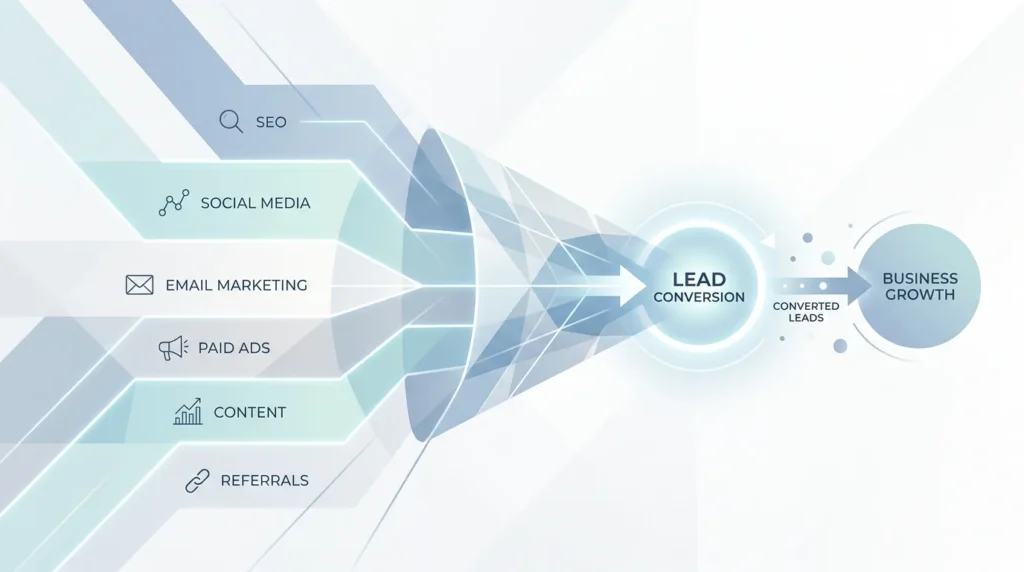
Imagine your marketing team is running a race with one goal: generating online leads that truly fit your company. Not “traffic”. Not “views”. Leads. In other words, people or businesses showing genuine commercial interest. That requires discipline and a system. And the good news is that you can tackle it in a very down-to-earth way: choose the right channels, create one clear path to conversion, measure it properly, and keep improving. Let’s make that practical together.
What “online lead generation” means in practice
In the real world, things go wrong when teams use the same word for different things. That’s why we start with a clear definition.
- Lead: a person or business that may have real commercial interest and that you can link to an inquiry, form submission, demo request, contact request, or a similar commercial signal.
- Marketing Qualified Lead (MQL): a lead that, based on your criteria, is likely worth marketing to, for example because of topic interest or fit with your proposition.
- Sales Qualified Lead (SQL): a lead that, according to sales criteria, is also genuinely promising, for example because the need matches and the timing or decision-making role is right.
Why is this so important? Because otherwise you optimize for something you don’t actually want. You can end up with plenty of “touchpoints” that still produce no pipeline. That feels busy, but it doesn’t drive growth.
For measuring “interest” and the path to conversion, an analytics approach is essential. GA4, for example, is based on the idea that you can measure conversions, such as when someone reaches a form, fills it in and ultimately converts into a customer. That fits lead-driven measurement very well. (Google also provides guidance on this.)
Tip from our team, based on practice: put your definition on paper early in the process. That makes your optimization less emotional and more logical.
The channel plan: how to combine SEO, SEA and content without clutter
Online lead generation is rarely one single channel that solves everything. It is a system that turns traffic into lead signals. Below is a channel plan that scales well in many B2B situations, from “we’re just starting” to “we already have data”.
1) SEO to build demand (TOFU and MOFU, with focus on intent)
SEO is not a generator of random traffic. SEO works when you write pages that address a specific search intent. You want to attract people who are already almost ready to compare or ask for something.
In practical terms, that means:
- Create content around concrete problems and use cases, not just abstract topics.
- Use a clear path to a lead moment, such as a template download, check or demo request.
- Work with internal links between supporting pages and your conversion pages.
For performance on Google Search, Google Search Console (GSC) is useful. It shows you how your site performs on Search, including information about impressions, clicks and pages. Use this to determine which pages you should sharpen. (Google also describes this in the Search Console documentation.)
Trade-off: SEO takes time. The main benefit is staying power. But if you do it well, your lead channel becomes more efficient over time.
2) SEA and PPC for direct lead flow (BOFU, with tight targeting)
SEA and PPC mean buying demand that already exists. That’s ideal for creating speed, especially when your pipeline needs attention now.
The quality of your leads then depends almost entirely on two things:
- Relevance between search term, ad and landing page.
- Conversion path: how quickly and clearly someone can reach the lead moment.
If you want to understand search engine advertising properly, this informative piece fits in well: SEA: What Is Search Engine Advertising and How Does It Work?
Practical approach: start with a small set of campaigns and landing pages that truly match your offer. Only spread your budget wider once your conversion data is stable.
3) Content marketing as a trust factor, not as a goal in itself
Content works when it answers the questions your ideal customer asks before getting in touch. At that point, content is no longer “filling a blog”. It is a navigation system.
What you do:
- Write around decision questions, such as costs, implementation, lead time, risks and success criteria.
- Build smart internal links to your lead pages.
- Make the next step logical, for example: “Do you want this for your situation?” with one clear CTA.
And yes, you need to measure it. Content that only gets traffic without lead signals is sometimes just a marketing ritual.
4) Social media and outbound as distribution and acceleration
Social media and outbound can speed up lead signals. But only if you connect them to the same conversion content and the same lead criteria. So use them as distribution and activation, not as separate channels without a path.
The conversion path: landing pages, forms and measurement that actually work
Many teams can get traffic. The difference between “we get inquiries” and “we get almost nothing” usually comes down to the landing page and the measurement setup.
Landing page checklist for lead quality
Your landing page does not need to be long. It does need to be clear. These are the elements that often make a difference in practice:
- Clear promise above the fold: who helps you, for which problem, and what it delivers.
- Proof and specificity: no vague claims, but concrete explanation of how you work.
- One primary CTA: no five buttons cannibalizing each other.
- Limited distraction: less navigation, less “noise”.
Forms: fewer fields, less friction, better conversion
If your form asks for too much, it goes wrong. People drop off. Not because they are dissatisfied. Because they feel the “effort”. And that is exactly what you want to minimize in lead generation.
In CRO research and practical material, there is consistent attention for friction caused by extra fields. HubSpot, for example, has material about friction caused by too many form fields and what you can ask. Other CRO-driven sources also emphasize that every extra step reduces the chance that someone finishes.
What we usually advise:
- Start with 3 to 5 fields for the first lead moment.
- Only make the second part “richer” once someone has already shown some intent.
- Use smart microcopy: “Why do we ask this?” often works better than extra explanation blocks.
Trade-off: fewer fields sometimes means lower qualification. So the answer is not “more fields”, but “qualify intelligently”. You can do that with short questions or an extra step that only appears when it makes sense.
Measuring in GA4: define conversions and keep tracking clean
If you take online lead generation seriously, you need to know what works. So you don’t just measure clicks, but also lead signals. In GA4 you can mark events as conversions and then report at the right level. Google Analytics also explains how you can use analytics to measure how people get to forms and submit them.
Concrete advice:
- Create one event for the lead moment (for example “generate_lead” or a similar name, internally consistent).
- Mark that event as a conversion so you can optimize for lead quality.
- Work with a clear set of conversions, not ten variations without a goal.
- Check your implementation in debug and test before scaling budget.
Limitation, to be honest: tracking is never perfect. People lose sessions, browse across multiple devices, and some integrations make it hard to connect everything 1-to-1. Your goal is therefore not “perfect proof”, but “decision-ready clarity”.
Distinguish between lead, meeting and Sales Qualified Lead
A form submission is not automatically a Sales Qualified Lead. That’s why you want a step in your process that sales can truly trust.
In practice:
- Record in your CRM when a lead is qualified.
- Report on MQL and SQL, not just on “signed up”.
- Also measure the time from first contact to meeting. Fast follow-up often makes more of a difference than an extra campaign.
Optimization in 30, 60 and 90 days: a roadmap you can actually execute
You need strategy, but above all you need pace. That’s why this roadmap exists.
Day 1 to 30: foundation and data quality
- Define lead, MQL and SQL criteria and document them.
- Check your landing page for message, friction and CTA focus.
- Make sure GA4 records the lead event correctly as a conversion.
- Use GSC to see which SEO pages already have momentum in search results and where you can improve CTR or positioning.
Why start here? Without a foundation, you optimize noise. Then you move in the wrong direction faster.
Day 31 to 60: sharpen campaigns and pages
- SEA or PPC: group by intent. Don’t let everything run through one campaign.
- Test landing pages with small changes. Think of the headline above the fold, CTA text, or form fields.
- Improve your qualification: if many leads don’t fit, change your questions or your selection in sales.
Practical rule: test one variable at a time if you can. Otherwise you won’t know what caused the effect.
Day 61 to 90: scale with discipline
- Scale budget on what produces consistent lead signals, not just one-off peaks.
- Create content that links back to your best converting landing pages.
- Optimize follow-up in your sales process. Fast response is often a silent conversion engine.
KPI suggestion: choose a small set of Key Performance Indicator, such as CPL (Cost Per Lead), CVR (Conversion Rate) from landing page to lead moment, and share of MQL and SQL. That helps you avoid steering on volume alone.
Common mistakes in online lead generation, and how to avoid them
Let’s be honest. Most problems do not come from “bad marketing”. They come from a logical mismatch.
Mistake 1: defining traffic as the goal
More sessions feels good, but sessions are not commercial signals. You want lead moments. So design your pages and campaigns around the lead path.
Mistake 2: one landing page for everything
When your audience is too broad, your message becomes generic. Generic rarely works for lead generation. Create landing pages per intent or per use case.
Mistake 3: optimizing for the wrong KPI
If you steer on click performance, you often get clicks that don’t fit. If you steer on lead moments, you get something better. And if you move on to MQL and SQL, you get real quality.
Mistake 4: tracking that is not correct
No reliable events, no reliable conclusions. So test and validate your implementation. GA4 lead tracking and conversions need to be clear and consistent.
Mistake 5: no follow-up process
Even the best campaign loses if follow-up is slow or unstructured. Set up a clear CRM follow-up rhythm.
Where we usually start: a quick approach for your next step
If you want to improve online lead generation today, this is what I recommend. Not big. But immediate.
- Choose one offer and one lead moment. For example, a demo request or contact form for one specific use case.
- Create or sharpen one landing page with one primary CTA and a form with minimal friction.
- Connect the lead moment to GA4 conversions. Check that the event really comes through.
- Activate one channel to create intent, for example SEA or SEO based on clear search intent.
- Measure CPL and CVR from day 1. Also report on MQL and SQL once sales has done the qualification.
And then, after two or three test cycles, you shift budget and content along with it. That’s how you grow organically and affordably, without guessing.
Conclusion: online lead generation is a system, not a trick
If we bring it back to one core sentence: online lead generation works when channel, landing page and measurement form one logical whole. SEO builds demand. SEA and PPC speed up inflow. Content strengthens trust. But the lead moment decides. And that is why we do not optimize for “buzz”, but for conversion of lead signals and the quality that sales sees.
Today, choose one offer, one landing page, one measurable lead moment. Clean it up. Test small. Scale only when your data supports it. Then you get no chaos, but a process you can build on.
