

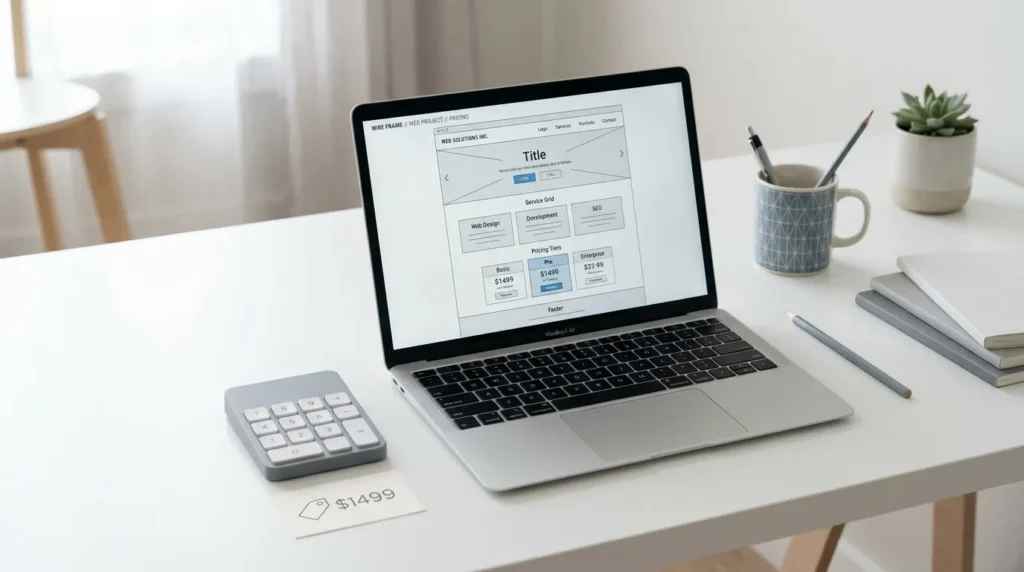
Alright, you’re looking for the website pricing. To be honest: if you only want one number, you’re bound to be disappointed. The price is not a mystery, but it does depend on choices you have not fully nailed down yet. And that is exactly where we can help you.
In practice, we see that the biggest price differences come from scope (what the site actually needs to do), execution quality (speed, detail, reusability), and the extent to which you use the website for online marketing and sales. So in this article, we give you a realistic way to understand costs, assess your quote, and take a next step that genuinely helps with Lead Generation and revenue optimization.
What really drives website pricing?
When people ask about “the price,” they often mean “the project budget.” But a website project usually consists of several building blocks. Some are visible. Others mainly show up in day-to-day use, in marketing, and in conversions.
Market information and common price ranges in the Netherlands show a broad spread, from a few hundred euros for simple sites to substantial projects for custom work and webshops. You also see that “more than just build time” is a recurring theme, because there are costs for content, hosting, maintenance, and technical optimization. (mkbhomepage.nl)
1) Type of website and scope (what must it do)?
The biggest control lever is scope.
- Business website with basic pages: usually landing pages, a services section, contact, sometimes a small portfolio or FAQ.
- Website with conversion-focused landing pages: more attention to structure, CTAs (Calls to Action), and measurability.
- More complex flows: bookings, requests, calculators, custom forms, integrations with your CRM (Customer Relationship Management).
- Webshop: an extra layer of payment providers, product management, categories, shipping logic, and conversion optimization at scale.
If your scope is vague, everything gets expensive, because then someone has to keep making decisions after the fact. And that is exactly the kind of “unexpected” cost item you’d rather not budget for.
2) Design approach: template versus custom work
Templates can be cheaper to start with. Custom design can fit your brand better, but it takes more design hours and iterations. In practice, you see that the price is not only in the beginning, but also in how easily you can keep building later and optimize for SEO (Search Engine Optimization) and conversions.
We usually recommend this: choose custom design only for the parts that genuinely make a difference for your marketing. Think about your most important pages, not every pixel on every subpage.
3) Content (copy, photos, brand assets) is often the hidden work
A website is never just code. Content also determines your conversion potential and your visibility. That is why quotes often include extra costs for:
- Copywriting or editing (page descriptions, service copy, call-outs)
- Photo and image editing
- Structuring your offer, including FAQs and case layouts
- Keyword research and translating that into page architecture
If you provide everything yourself, build time can go down. But if you only create the content after the site is “almost finished,” you often end up with extra rounds. That is frustration with an invoice attached.
4) Technology and integrations (with marketing and sales in mind)
Do you want your website not just to be online, but to become a Lead Generation machine? Then integrations matter.
Many projects revolve around connections with:
- Contact and request forms with CRM (so follow-up is faster)
- Tracking and reporting (so you know what works)
- Common automations and workflow integrations
For modern marketing, being “measurable” is not a luxury. It is the baseline. If you do not measure, you optimize by gut feeling. And gut feeling is fine, until your budget runs out.
5) Maintenance, hosting, and ongoing development
A website comes with recurring costs, such as hosting, domain, and maintenance. In practice, you see that providers also offer monthly or annual maintenance packages, because updates, security, and small improvements are part of the whole. (mobilions.nl)
Price ranges and cost items: what can you realistically expect?
We are deliberately keeping this practical. You do not need to use our exact calculation. You do need to understand which parts belong in the price, so your quote matches your intention.
Typical cost items in a website project
- One-off costs: design, web build, technical delivery, content structure, basic SEO, possible integrations.
- Content costs: copy, visuals, copywriting, possible SEO elements such as keyword structure.
- Subscriptions: hosting and domain (usually annual).
- Maintenance and management: updates, security, small improvements, optimizations.
- Measurability: setup for reporting and conversion tracking, so you know what happens after clicks and inquiries.
Examples of price ranges (indicative)
Note: these are guideline ranges based on publicly shared price indications. Your project may differ. (ontwikkelaars.nl)
- Simple professional sites: often a few thousand euros for a basic setup, depending on page count and content.
- SME websites: regularly several thousand euros, especially if you want conversion-focused pages and a technical foundation for SEO and tracking.
- Custom work and more complexity: quickly higher if you add integrations, web tools, many pages, or webshop functionality.
What we especially want to avoid here: that you think “we want a site” and a agency then creates a quote as if it were a full marketing programme. Or the other way around, that you think “it is only a site,” while in reality you need lead follow-up and a conversion flow.
Annual costs: do not underestimate this
In addition to build costs, there are often fixed annual costs for domain and hosting, plus maintenance. In practice, you see that maintenance and management often return monthly or annually. (mobilions.nl)
How to assess a quote without falling into the pricing trap
If you sit with us at the table in the office, we do not just look at the total amount. We look at the assumptions behind the amount. That sounds logical, but it is often forgotten.
Step 1: make scope reappear in pages and functionality
Ask explicitly in your quote review:
- How many pages are included in the price?
- Which pages are conversion-focused, and what is the approach per page type?
- Which functionality is included and excluded from delivery?
- Which integrations are included (and what technical input do you need to provide)?
Why this works: scope is the basis for hours. If scope is not clear, hours become “less controllable,” and you will see that reflected in margins and extra work.
Step 2: check what “basic SEO” means in this quote
SEO is not a magic button. In a website project, you at least need to get the basics right.
For example, ask:
- Is there attention to titles, meta structure, heading structure, and internal link logic?
- Is there a technical foundation for indexing and performance?
- Is content structure linked to search intent (not just keywords)?
Note: this is about technical and content structure. It is not a guarantee that you will rank high immediately. But it does give you a foundation you can develop further later.
Step 3: measurability and CRO (Conversion Rate Optimization) must be part of your build plan
If your website is meant for Lead Generation, then you need to know where requests come from.
Practical questions for your quote:
- Which conversions are measured (for example form submissions, bookings, or quote requests)?
- Where is the data sent (reporting and CRM follow-up)?
- Who builds and manages the basic tracking?
Why this works: you can only improve what you can see. In marketing terms: you want to move faster from “we think” to “we know.”
Step 4: treat maintenance and development as part of your total investment plan
Ask for:
- What is included in maintenance?
- What falls under management and what under development?
- How are small improvements scheduled?
This prevents you from later needing a new quote for simple changes, such as extra landing pages or adjusting forms for better CVR (Conversion Rate).
Website pricing in relation to online marketing and sales optimization
Here comes the broad truth: a website is rarely the end product. It is the engine your online channels connect to.
Why your marketing strategy affects your website price
If you are already using Search Engine Advertising, meaning ads based on search queries, then your website affects performance. A poor landing page makes your PPC more expensive, because it does not keep pace with the ad promise.
Want to know how advertising costs compare to what you need on landing pages? Use this practical article as a starting point: Google Ads costs: what does advertising on Google cost?
If you focus on inbound: build pages that fit your funnel
Inbound marketing is about a sustainable pipeline. Your website therefore needs to support content and conversion steps that fit the stage in the funnel, for example TOFU (Top, Middle, and Bottom of the Funnel), with informational pages, and MOFU (Middle) with directional content, and BOFU (Bottom) with offers and entry points.
Want a strategy that helps you move from content to real sales opportunities? Read: Inbound marketing strategy: how to build a sustainable pipeline and Inbound marketing: the practical guide to more pipeline.
Why this affects price: if your website is only informational, the build can be simpler. If your website is meant to collect inquiries, you need to build conversion flows, set up forms intelligently, and often design content blocks with measurability in mind.
Automation and CRM follow-up: the price of speed
Many organizations do not lose deals because of “too little traffic,” but because follow-up is too slow. That is where automation comes in.
We often see it like this: form submitted, but lead information is sent back to CRM too late (or not properly). Then value is lost. With automation, you can respond faster and improve lead quality. More on that: AI Automation: making marketing processes smarter.
Practically, this often means your website:
- Collects the right data
- Consistently passes it on to CRM
- Triggers follow-up actions
Yes, that can increase the website price. But it can also reduce the cost per relevant action, because you have less “junk leads” and follow up faster.
Why we always look at your sales process too, not just the site
A website that converts well is great. But if sales does not qualify leads quickly, it still becomes a step toward delay.
That is why we like to ask: how does a visitor go from website to appointment, and how does that appointment become a Sales Qualified Lead (SQL) and then a customer? If you use inbound as the foundation for that, a clear path helps. For example, via Inbound marketer: strategy that actually builds pipeline.
What is the best next step if you want to know website pricing?
You do not need to start with a full agency project. Do it smart and in phases.
Next step 1: create a quote checklist in 30 minutes
Take your project and fill this in (briefly, without trying to make it perfect):
- Website goal, Lead Generation through requests or bookings, or mainly brand and reach
- Number of core pages and which pages should be conversion-focused
- Which functionality you need (forms, bookings, integrations)
- Who provides content (and when)
- Which measurements you want (which conversions)
- Who does CRM follow-up and who manages tracking
Then you can compare quotes without falling into “wow, that sounds fancy” or “it is cheaper, so it must be fine.”
Next step 2: choose a starting depth that fits your maturity
If you are still measuring little and do not yet have lead follow-up in place, then “everything at once” is often too much. In that case, a phased approach is usually smarter, for example first a basic site plus measurability, then development toward extra landing pages, content, and automation.
Next step 3: plan a marketing-focused technical intake
What you want is for us to treat the request as a marketing project, not just a build project. That means your website price is not separate from:
- which channels you use
- which conversions you want to drive
- what your follow-up looks like
If you think more broadly about collaboration and approach, this can help you choose the right direction, for example: Digital Marketing Agency: Modern Marketing Solutions or Best Online Marketing Agency: Selection Guide and Comparison. For extra focus on channel strategy, this is also useful: Social media marketing agency: strategy and approach.
Conclusion: do not just pay for a website, pay for a conversion system
Website pricing is not a fixed amount. It is the sum of scope, content, technology, integrations, and ongoing development. The reason prices vary so much is that a website for online marketing and sales needs a different level of quality than a static brochure online.
If you want the right quote now, do this: make scope clear in pages and functionality, ask for measurability and conversion approach, check maintenance and development, and make sure your website connects to your marketing and lead follow-up. Sounds simple. Often it is, as long as you ask the right questions.
If you want, you can share your current wishes or a rough quote (scoped in bullet points) here. Then we’ll help you translate it into a realistic budget and an approach that fits your online sales goal.
