
 Written by
Daniel van Hek
Search Clicks·August 27, 2026
11 min read
Written by
Daniel van Hek
Search Clicks·August 27, 2026
11 min read
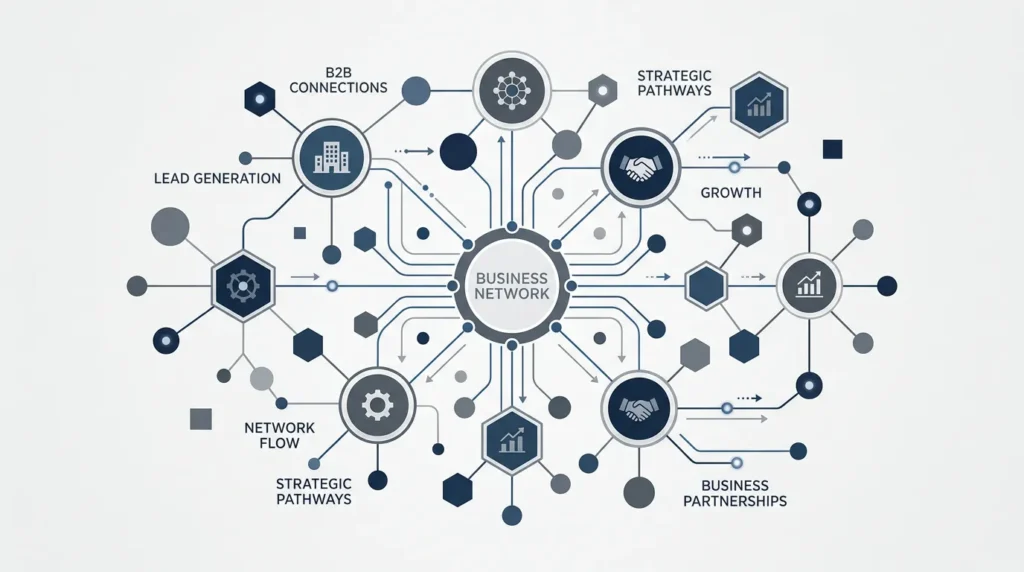
Let’s be honest: a lot of B2B lead generation feels like pushing against a closed door. You pour traffic and campaigns into the system, optimize for volume, and still the quality stays mediocre. That’s a waste of your time and budget.
In practice, it almost never comes down to “the marketing isn’t good enough.” The problem usually sits in the foundation. Think of an unclear ICP (Ideal Customer Profile), an offer that doesn’t spark enough interest, or tracking that doesn’t show what really happens after the conversion. And then you get KPI’s (Key Performance Indicator) that do move, but don’t lead to sales-ready conversations.
That’s why we approach B2B lead generation as a system. Not as a separate tactic. We set up the chain from awareness, interest and contact, all the way to qualification and follow-up. Google also explicitly names E-E-A-T as a framework for content quality: experience, expertise, authority and trustworthiness. You can translate that principle directly to lead generation, because your prospects need to build trust before they share their contact details. (developers.google.com)
Your ICP is not a persona poster. It’s a filter that aligns your campaigns, content and sales follow-up. We work with three layers:
If your ICP stays vague, you’ll naturally start steering toward the wrong leads. Then it looks like you’re getting “lots of leads,” but you’re mostly filling your CRM with people who have no real interest. In lead generation, that’s the fastest way to stumble later in your funnel.
A strong proposition is not a slogan. It’s a clear exchange between you and your prospect:
A practical rule that often works: make the first step small, but not meaningless. A “whitepaper” is fine for TOFU, but for B2B lead generation aimed at sales you also want content or a process format that shows you really understand the topic. That’s exactly where E-E-A-T helps, because it makes your experience and expertise visible in your landing page, form and follow-up. (developers.google.com)
Many teams talk about “leads,” but mean three things at once. That makes optimization impossible. That’s why we put definitions on paper, so marketing and sales speak the same language.
This is not bureaucracy. It’s the basis for decisions. If you optimize only on lead volume, you unintentionally reward low intent. Your cost per lead (CPL) may go down, but your sales pipeline stays thin.
For B2B lead generation, a combination of channels almost always works best, because B2B buying is rarely impulsive. Your prospects need to see the same quality several times, or at least receive the right signal at the right moment.
SEO is great for durable inbound flow. But SEO “on its own” does not generate leads. It only becomes lead-worthy when your content:
Google stresses that content should be helpful to people and that quality is linked to E-E-A-T. Translate that into: show that you understand the topic, demonstrate experience, and stay consistent in your communication. (developers.google.com)
Search Engine Advertising (SEA) and Pay-Per-Click (PPC) are often the fastest way to test leads. But in B2B, you should not only want clicks. You want intent. That’s why:
A landing page has to deliver on the promise in your ad. Short, concrete and with a clear CTA (Call to Action). LinkedIn, for example, states that landing pages with fewer fields and a stronger CTA can improve conversion, and that mobile accessibility matters. (business.linkedin.com)
With social ads, we see some teams win on CPL and lose on SQL. That happens because they target too broadly, or ask too little qualification at the moment of contact.
Lead forms can help lower friction. LinkedIn says you can use lead gen forms to simplify completion and measure lead form fill rate and cost per lead. (business.linkedin.com)
Our advice: use lead forms for capture, but make sure your routing and qualification connect immediately. So not “leads come in, sales will figure out later what to do with them.”
Outbound works especially well in B2B if you:
We often see the difference in the second and third email. The first email is your ask. The next messages are your mini case and your relevance.
Lead qualification is where most B2B teams look too late. They spend time on campaigns, but then leave response and follow-up too much to chance. Yet this is where you often recover the ROI of your lead generation.
What you don’t measure, you can’t improve. That’s why we set up a simple operation:
You can partly automate this, but with human control where it matters. Automation should make your follow-up faster, not faster and clumsier.
ICP fit matters. But intent is what fills your pipeline. That’s why we use signals such as:
This helps your marketing make MQLs more consistent. It helps sales recognize SQL faster.
For B2B lead generation, it’s not just about marketing performance. You also have to process personal data lawfully. In Europe, for example, GDPR applies. The European Commission explains that you need a valid legal basis and discusses legitimate interests and consent, plus the role of ePrivacy rules for direct marketing via email. (commission.europa.eu)
The Information Commissioner’s Office (ICO) also provides B2B guidance on lawful basis and the relevant rules for direct marketing via electronic communications. (ico.org.uk)
Translation into execution: set up your consent and opt-out processes properly, and make sure your lead sources are demonstrably compliant. That’s boring, but it keeps your system from being put on pause later.
If your tracking is off, you optimize noise. And noise always feels busier than the real problem. So: we make the funnel measurable from start to finish.
We recommend a base you can trust:
Important: a visit is not a lead. Only when you have contact details or a real commercial enquiry do we call it a lead. That prevents you from optimizing your KPI’s around “presence.”
We choose a set of KPI’s that tells the story:
It’s tempting to look only at CTR (Click-Through Rate) or click volumes. But CTR mainly says something about ad copy and targeting. For B2B lead generation, SQL rate is often the fairest indicator of real value.
Testing is good. But you don’t want to change everything every week. We often work with:
With lead forms and landing pages, we often see quick wins from reducing friction and qualifying smartly. LinkedIn, for example, mentions conversion improvements and the importance of best practices for lead gen forms. (linkedin.com)
Okay, enough theory. Here’s a plan that we often see work in practice, because it focuses on the bottlenecks that usually hold back B2B lead generation.
If you execute this tightly, you get something valuable: clarity. You’ll see which links add value, and which ones only produce leads without sales impact. And yes, sometimes that feels like bookkeeping. But they are the right numbers.
If you want to take a broader approach, this guide fits well with our foundation: Leads Generating: Complete Guide to B2B Lead Generation.
B2B lead generation works when you approach it as one chain. You start with a sharp ICP and a proposition that offers a clear exchange. You define leads, MQL and SQL so you’re not steering on volume. You use multi-channel based on intent, and you make sure landing pages and forms deliver on the message.
Then comes the real difference: qualification and follow-up. With good tracking and consistent routing, you can see which campaigns really build pipeline. And then optimization stops being a guessing game and becomes a process.
If you want to choose one next step: get your lead definitions and routing in order this week, and measure SQL rate per channel. That gives you steering information faster than another round of ads. After that, we iterate on offer, pages and targeting. Step by step, without magic, but with results.
Book a free strategy call and discover how many leads we can generate for your business. No obligations — just a concrete growth plan.
Book your free strategy call → Book your free strategy call — 30 min, no strings attached