
 Written by
Daniel van Hek
Search Clicks·August 30, 2026
10 min read
Written by
Daniel van Hek
Search Clicks·August 30, 2026
10 min read
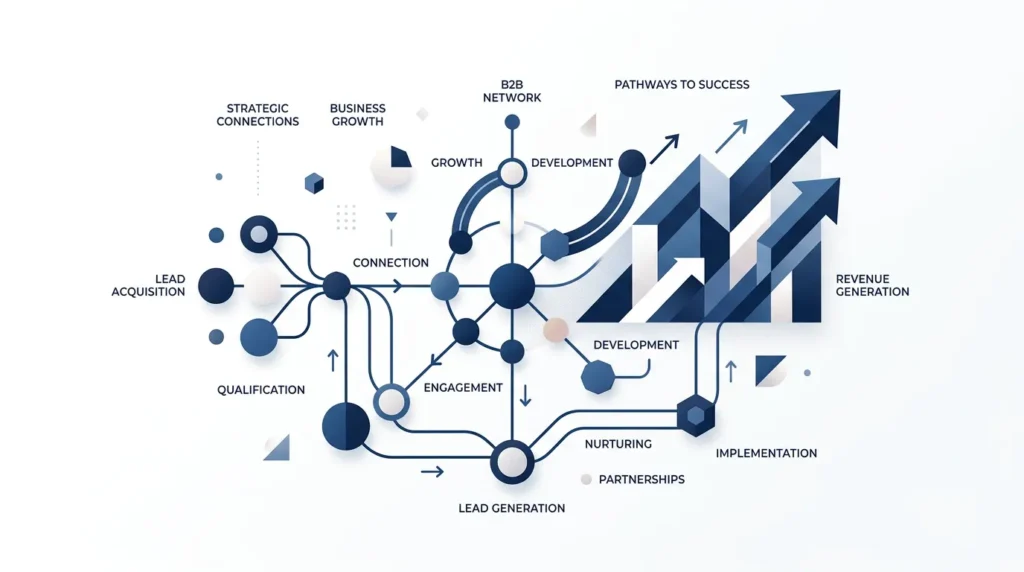
Grab your coffee for a moment. If “b2b lead generation” is your goal, chances are you’re already doing something, but it isn’t consistent enough yet. Maybe you are getting form submissions, but not the right companies. Or you are getting conversations, but only after sales has already been chasing for days. No drama, this is exactly where a tactical plan makes the difference.
In this article, we lay out an approach you can put into action right away. We focus on online marketing and online sales optimization for B2B. We keep it practical, but we also explain why certain choices work. And we end with a clear next step, so you don’t get stuck in “let’s test a bit more.” Because testing is fine, but testing without a measurable agreement with your data is a waste of time.
The biggest mistake in b2b lead generation is that teams call everything a “lead.” Visitors, downloads, webinar sign-ups without contact details, or even just a click on an ad. That is not the same thing. A lead is only a lead when there is a person or company with a genuine commercial interest, and contact or company-identifying data has also been captured.
Why does this matter? Because it stops marketing from being judged on “leads” that were really just curiosity. And sales is no longer judged on incomplete signals. This is also how you turn “quality” into measurable definitions.
For online b2b lead generation, you need to measure what you actually want. In web analytics, that happens through events that you mark as conversions in Google Analytics 4. In Google Analytics 4, this is conceptually called “conversions” based on events, so you can measure important actions consistently across channels. (support.google.com)
In practice, that means you only mark events as conversions when they match your lead definition. Think: “lead_form_submit,” “demo_request_complete,” or “quote_request_sent.” And you set up separate events for “not enough intent” (for example, “form_started” but not submitted).
There is no magic button for b2b lead generation. You get quality when your channel choice matches your ICP and your follow-up rhythm. We usually work with a mix of two worlds:
For many B2B companies, the barrier is higher than in B2C. People are not just looking for “something nice,” they are looking for a solution. That is why it often works well to:
If you use a generic “contact us” page as your main landing page, you will get traffic that clicks, but does not always fit. Better: landing pages by use case and by stage. Think:
Watch the trade-off: more landing pages mean more management. But it does give you a better fit between the ad or search query and the form. That increases your CVR (Conversion Rate) and usually your MQL share too.
Outbound can be excellent for b2b lead generation, but only if your lists and messaging are strong enough. What often goes wrong:
That is why we steer on lead scoring based on context. Not just “who are they,” but also “what do we know about their situation.” That can come from website signals, form choices, or previous content consumption. Only after that do you tailor the follow-up.
Let’s be honest. You can have the best channel, but if your conversion tracking is vague, you will optimize on the wrong signals. And if your forms have friction, you will get a lot of “wrong” leads, because only people with a low enough threshold still submit.
For B2B, it is often perfectly fine to ask for more fields, as long as you explain why. People need to understand why you need that information for proper follow-up.
Practical checklist:
In Google Analytics 4 (GA4), conversions are created based on events, so you can steer measurably. (support.google.com)
We recommend defining at least the following event families:
And then the most important step: you connect those definitions consistently to your dashboards. Not to have fancy reports, but to prevent marketing from optimizing on volume while sales is looking for value.
With b2b lead generation, personal data processing is often involved. In the European context, there are rules around GDPR and the ePrivacy Directive. The European Commission, for example, emphasizes that you need a lawful basis, and for direct marketing via electronic communication, consent or another legal exception plays a role. (commission.europa.eu)
Practically, this means for our work:
We do not need to play lawyer here. But you also cannot pretend this will be handled “later.” It always comes back, usually right when you have momentum.
Lead quality is rarely just about targeting. It is also about speed and routing. Who calls whom, when, and based on which criteria?
A simple working method we often use:
Why does this work? Because lead quality in B2B is created where intent and feasibility meet. Marketing sees intent. Sales sees feasibility. Together, you turn that into a system.
Even if your targeting is perfect, a slow response can cost you opportunities. Make sure your CRM follow-up has a standard. Think:
Watch the trade-off: overly aggressive follow-up lowers quality and can create consent issues. So do not only optimize for speed, optimize for relevance too.
Automation here means software and workflows that streamline lead capture, enrichment, qualification, follow-up and CRM updates. In our practice, that works especially well for:
And an important boundary: automated systems must not make budget changes or contract decisions without human approval. You want speed, not chaos.
Okay, no theory. Here is a 5-step approach that we often use as a starting point in projects. You can set this up in 1 to 2 weeks, depending on your current tracking and CRM setup.
You do not just measure volume. You measure:
Tip: if MQL is good but SQL is low, the issue is usually sales fit, product framing, or timing. If MQL is low, the issue is targeting or form qualification.
If you want a broader guide for structure and channel choices, you can also use this: Lead Generation: Complete B2B Lead Generation Guide. Think of it as a supplement; here we are mainly building the practical implementation layer beneath it.
If you take b2b lead generation seriously, your biggest gain is not one campaign, but the system behind it. Definitions, tracking, landing pages, qualification and routing all need to work as one chain.
What can you do today? Start with the lead contract and your conversion measurement plan. Then adapt your landing pages to use case intent. Finally, set up a follow-up rhythm that combines speed with relevance.
And if you get stuck anywhere, ask yourself one simple question: “Are we optimizing the right step in the funnel?” If the answer is no, you can keep clicking, but you are probably mostly selling hope. And that is not what we are going for.
Book a free strategy call and discover how many leads we can generate for your business. No obligations — just a concrete growth plan.
Book your free strategy call → Book your free strategy call — 30 min, no strings attached