

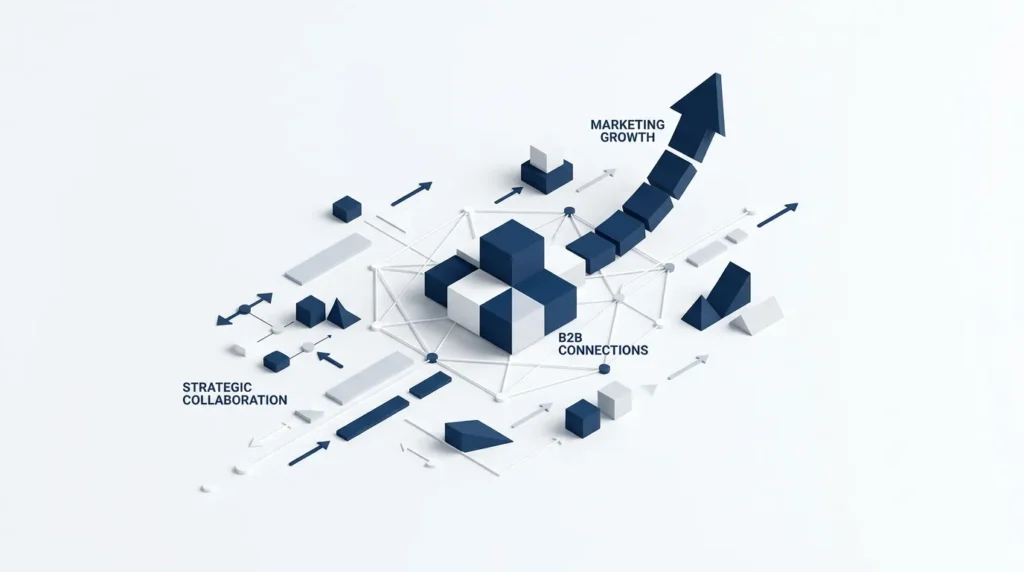
To be honest, “a B2B marketing agency” sounds to many professionals like one of two things: either a supplier that mainly runs campaigns, or a crew with nice strategy slides and little real pipeline control. You want something in between. Something practical. Something measurable. And above all: something that lifts online lead generation to a level that sales can actually feel.
In this article, we walk step by step through how we approach a B2B marketing agency (and what to look for when choosing one). You get a clear strategy, concrete execution, and a measurement plan that doesn’t depend on hope or gut feeling. Nice, right, marketing people actually want to talk about at the table.
What does a B2B marketing agency really do, and who is it for?
A B2B marketing agency is not a “management team” that spends a bit of budget every week. It is a team that optimizes online marketing and online sales for your commercial goals. Think about:
- Lead generation through Search Engine Optimization (SEO), Search Engine Advertising (SEA) and conversion optimization
- Guiding demand to the right landing pages, forms and booking paths
- Marketing Qualified Leads (MQL) and Sales Qualified Leads (SQL) improvement through better targeting, better content and better follow-up
- Measurement and adjustment based on Key Performance Indicator (KPI) sets, not on dashboards
Who is it for? In practice, mainly B2B companies with one or more of these situations:
- You have an offer, but the online demand is not coming in at the right level.
- You are getting leads in, but quality and flow to sales are inconsistent.
- You do SEO or SEA, but you do not measure success like a funnel (visit to conversion to qualified intake).
- You lack the time or senior expertise to handle tracking, CRO and channel optimization properly.
Important to say: an agency cannot “automatically” deliver revenue for you. What we do is improve the odds. More relevant intent, better conversion, and faster feedback into campaigns and sales. That is usually the difference between “busy” and “commercial impact”.
The core strategy: from demand to a qualified meeting
If we look honestly at B2B lead generation, it rarely works like this: we get clicks, and we hope someone calls. A good approach is funnel-based and measurable.
1) Start with your ICP and intent, not with your services
Your Ideal Customer Profile (ICP) needs to be concrete. Not as a little text on your homepage. But as a list you can translate into:
- Search intent (what are people searching for when they really want to buy or decide?)
- Organization types and roles (who decides, who influences?)
- Deal criteria (which conditions make a lead “usable”?)
Why this works: without intent and ICP match, you get traffic, but not the right commercial conversations. Then your team ends up optimizing for the wrong KPI’s.
2) Translate TOFU, MOFU and BOFU into pages and campaigns
You can have content and still fail on lead quality. That is why we connect Top, Middle, and Bottom of the Funnel (TOFU, MOFU, BOFU) to landing pages and ad claims.
- TOFU: education with soft conversion (for example download or sign-up)
- MOFU: comparison and use cases, aimed at qualification
- BOFU: demonstration of value, with a booking path and clear screening questions
Trade-off you need to accept: BOFU conversion may look lower than TOFU. That is not bad. You are buying less “volume”, but more real opportunities. Our job is to keep that balance in check.
3) Make your conversions “real”, through tracking that works
You can only optimize if you measure conversions reliably. In Google Analytics 4 (GA4), conversions work through events that you mark as Key Events. The official documentation explains how to use Key Events to measure conversions and use them within campaign optimization. (support.google.com)
In addition, in Search Console you need to understand what clicks and impressions mean for your SEO and advertising behavior (here too Google gives context on how metrics are counted). (support.google.com)
Practical advice: define at least three KPI layers.
- Micro-conversions (page engagement, form start, demo request start)
- Lead conversions (full form or booking request)
- Sales conversions (SQL, intake meetings, and preferably outcome after first contact)
This helps you avoid one classic problem: optimizing for “leads” that sales never sees as opportunities.
SEA and SEO together: how to match reach and intent
A B2B marketing agency that only runs SEA often misses long-term returns. An agency that only does SEO can be too slow for your pipeline. The smart approach is a blend: SEA to capture intent and SEO to build durable demand.
SEA for B2B: focus on conversion quality, not click strength
In B2B, click-through rate (Click-Through Rate, CTR) is a nice signal, but not the end goal. You want:
- relevant search terms based on ICP and decision intent
- ad copy that matches the landing page content
- a landing page that supports selection and qualification
Why this works: in B2B, the costs of “misfit leads” are high. Your sales team costs time. That is why we steer SEA on Key Events that sit close to meetings or intake, and use performance signals to adjust bids and targeting.
SEO for B2B: build topic authority with conversion in mind
SEO is not just about rankings. It is about finding people with buying or decision intent, showing that your solution fits, and then getting them to take a step.
This is how we approach it:
- Keyword clustering by intent, not by isolated terms
- Landing pages per cluster, with a clear booking path
- Internal links that push visitors toward MOFU and BOFU
If you are looking for an agency, ask how they connect SEO to conversion and lead quality. Not just “traffic growth”, but which pages and which events are being improved.
Helpful follow-up reading
If you want to dive deeper into how agencies combine SEO and SEA, this explanation helps: Google Marketing Agency: SEA and SEO specialists explained. For clear online lead paths, B2B Leads Generation: Tactical Implementation. Brief can also be useful.
CRO for B2B: why your landing page is the real campaign
Your campaigns can be excellent. If your landing page does not convert, you are paying for frustration. In B2B, we often see that CRO makes the fastest measurable difference. Not sexy, but effective.
What we optimize on a B2B landing page
We focus on three things, in this order:
- Relevance: does the promise match the ad or search intent?
- Selection: does the page help the right visitors and filter out the wrong ones?
- Path: is the next step logical, fast and measurable?
Concretely translated into elements:
- 1 clear main message above the fold
- a short set of qualification questions in the form or booking path
- minimal friction, only fields sales needs to qualify
- social proof that fits B2B decision-making, preferably concrete and relevant
- a Call to Action (CTA) that fits the moment, for example “Book an intake” or “Request a consultation”
Measurement plan: which KPI’s are leading?
In B2B CRO, it is about more than CVR (Conversion Rate, Conversion Rate) of form submit. We look at the step after that, because that is where many teams fool themselves.
Practical KPI set we often use:
- CVR to lead event (what happens on the page)
- Lead qualification ratio (MQL to SQL, or intake to qualified sales)
- Response time (how quickly sales calls or emails)
- Cost per lead (Cost Per Lead, CPL) and then cost per SQL (once you have that data properly)
This prevents you from optimizing for “high CVR” while the pipeline stays empty. Yes, that happens. Regularly. And yes, it is frustrating.
Targeted help with conversion and planning
Do you want an agency that turns landing pages and conversion into a system too? Then this topic fits: Search engine optimization agency: how to choose smartly.
Lead nurturing and follow-up: from MQL to SQL without spam
A lead is not yet a commercial opportunity. That is why lead nurturing is part of a B2B marketing agency’s work. But we do it without noisy newsletters and copy-paste emails.
The basics: choose moments in the funnel
We design nurture around the moments you really encounter in B2B:
- After first contact (confirm promise and expectations)
- After education (summarize, push again toward BOFU)
- After a missed meeting (politely reschedule with new context)
Which email approach works in B2B
For email marketing agency work, we focus on structure and execution. If you want to read how we connect strategy and execution, take a look at: Email marketing agency: strategy, execution and growth and, specifically for business clients: Email Marketing B2B: strategies for business clients.
Important: we use email as support for conversation. Not as decoration. In practice, that means:
- one goal per email (CTA clear and measurable)
- content that matches the reason someone signed up
- segmentation based on intent or form choice
- automation with human oversight at critical moments
Automation where it makes sense
By automation, we mean software and workflows that optimize online marketing and online sales. Think about:
- lead capture and enrichment, then sending it through to Customer Relationship Management (CRM)
- follow-ups and reminders, with clear timing
- updating fields in CRM so sales always knows what happened
- reporting that links KPI’s per campaign and per landing page
We do not use automation to change budget or contractual decisions without human approval. That is too risky. We use it to improve consistency and speed.
How do you choose a B2B marketing agency that really optimizes online?
You do not want an agency that sells you “a process”. You want an agency that monitors and adjusts your commercial engine. Below is a checklist you can use right away.
1) Ask about their measurement plan
A good agency does not only talk about creative. They talk about tracking and KPI’s. Specifically:
- which events are Key Events in GA4 and why? (support.google.com)
- how do they check that clicks and performance in Search Console are correct for your interpretation? (support.google.com)
- how do they match ad conversions with CRM outcomes?
If the answer is vague, that is a signal in itself.
2) Look at their landing page approach
Ask which optimizations they do first. Good answers talk about:
- promise match between campaign and page
- forms that qualify, not just collect
- CTA and path that fit BOFU behavior
If they mainly talk about ad copy but very little about pages and events, then something is missing.
3) Ask how they prioritize
B2B marketing is not endless. You have a backlog. A senior agency explains how they choose priorities:
- what delivers the most within the funnel
- what is quick to test
- what requires more data or sales feedback
4) Pay attention to specializations without losing the bigger picture
An agency can provide multiple services. But it must be clear who takes responsibility for what. If, for example, you want focus on email as a nurturing engine, this helps: Create an Email Campaign: Step-by-Step Guide. Or if you see SEO content and link building as part of growth: Link building agency: strategy, approach and costs.
5) Realistic expectations
SEO takes time. SEA can deliver signals faster. CRO can often deliver improvements faster. That is not an excuse, that is planning. A good agency explains this, including trade-offs.
What is the next step? A workable start plan in 14 to 30 days
If you want to start with an agency today, this is the start plan I would use. You want speed, but with a solid foundation.
Week 1 to 2: measurement foundation and funnel diagnosis
- Audit tracking: Key Events, lead events, and CRM connections
- Bring together Search Console and channel data to understand SEO performance and intent (support.google.com)
- Validate GA4 conversion events so optimization is real (support.google.com)
- Review landing pages for relevance, selection and path
Week 3 to 4: SEA and landing page improvements
- Restructure SEA around ICP and intent
- New or sharpened landing pages, with qualification questions
- A/B tests or iterative improvements to CTA and form logic
Week 5 to 8: nurture, qualification and optimization cycle
- Set up nurture flows for MQL to SQL movement
- Build in sales feedback so you refine qualification definitions
- Set up KPI dashboards that support decisions, not just reporting
If you read this and think “okay, but where do we start in practice?”, then my advice is: start with the measurement foundation and the landing page. Without those two, you can spend a lot of money on traffic. With those two, you can turn traffic into opportunities.
Conclusion: a good B2B marketing agency is an optimization partner
A B2B marketing agency is valuable when it optimizes online marketing and online sales as one system. That means: ICP and intent at the center, funnel-based pages and campaigns, clear Key Events, and lead nurturing that truly helps sales.
If you take only one thing away: measure what you really want, steer on that, and improve the places where things go wrong. The rest is execution. And execution is something you can train, secure and accelerate. That is where we make the difference as professionals.
Do you already have SEA or SEO live, and what is your current “lead” definition? If you share that, we can map out a realistic KPI set and order of optimizations together.
