
 Written by
Daniel van Hek
Search Clicks·August 28, 2026
8 min read
Written by
Daniel van Hek
Search Clicks·August 28, 2026
8 min read
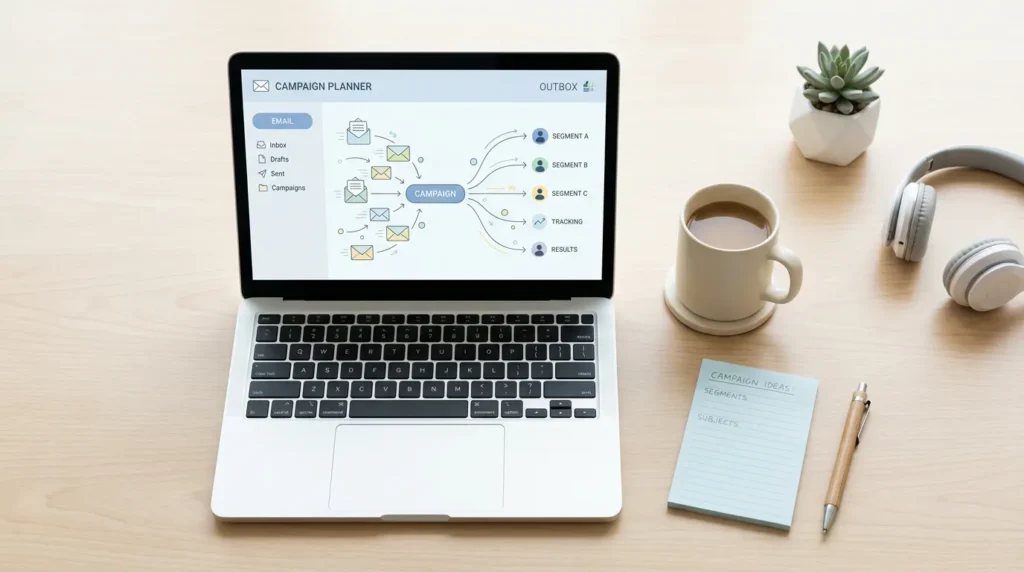
Grab your coffee. We’re going to talk about email campaign creation, but in a way you can put into action tomorrow. Not as abstract theory, but as a practical workflow with choices you understand and can measure.
If you’ve ever thought, “We sent it, so why did no one respond?”, the problem is almost never just the subject line. It’s usually the basics: your audience, your timing, your deliverability, and your measurement plan. Let’s build that chain properly from scratch.
A strong email campaign starts with one simple question: what do you want someone to do after your message lands in their inbox?
Then choose your audience. Not “everyone who ever bought something from us.” That is usually too broad and too late. You want people who genuinely feel the relevance right now.
We don’t use vague terms for this. You choose a result type, and you define how you’ll measure it.
Note: you want to measure the difference between an interested person and real commercial intent. That’s why you usually need multiple levels, such as a Marketing Qualified Lead (MQL) and a Sales Qualified Lead (SQL), depending on your internal definitions.
In practice, I see segmentation only becoming valuable when you adapt both the email content and the CTA (Call to Action) to it. Think about:
Google’s inbox behavior also makes it clear that users judge emails differently by type. Gmail sorts messages into categories such as Primary and Promotions. Promotional or commercial emails often belong in Promotions. That doesn’t mean you’re “out of luck,” but you do need to shape the experience accordingly. (support.google.com)
Your content can be excellent. If your deliverability is poor, you won’t even see your own data come through. And if compliance is missing, things can turn into a mess you don’t want in your planning.
For anyone targeting Gmail accounts, Google’s guidelines for bulk email matter. Google mentions requirements around authentication, spam-rate behavior, and a one-click unsubscribe mechanism for relevant traffic. (support.google.com)
In practical terms, this means for your email campaign:
In the United States, the CAN-SPAM Act applies to commercial electronic mail. The FTC explains that the law sets rules for commercial messages, including the right to stop and rules around the opt-out option. (ftc.gov)
Translated into practice:
Keep in mind this is a high-level legal summary. For exact interpretation, it’s wise to have your lawyer or compliance partner review it, especially if you send outside the US.
Now for the fun part. You don’t just want to “make an email.” You want to show a small conversation script. Short, relevant, and with one clear next step.
Keep your structure tight. In practice, this format often works:
And yes, let’s say it plainly: if you hide five CTAs in your email, you’re giving the recipient a choice-stress package. That’s rarely a win.
Your subject line is not magic. It’s a match test between what you think is relevant and what the recipient expects.
If you’re unsure, test variations. Not because “testing always” is the rule, but because it lets you target your message to a specific group.
Your email campaign needs a destination. Without a landing page that matches your promise, you’ll frustrate your own conversion.
Make your landing page consistent with the email:
For measurement, you want to capture events reliably. Think conversions and micro conversions, and connect that to your CRM (Customer Relationship Management), so your MQL or SQL definitions are correct. Without this, you may see clicks, but not commercial value.
Let’s keep it practical. You don’t want an endless list of tweaks. You want a plan that teaches you what works, by segment and by step.
A simple but effective measurement model:
Open rates are useful, but again, they don’t tell the whole story. You mainly want to know whether people continue to the step that creates commercial value.
A good order for tests in an email campaign:
That way, you don’t optimize blindly. You try to locate the problem.
Be honest about what you can and can’t measure. If you influence offline sales and your connection isn’t strong, then your “conversion” in reporting is more of a proxy than the truth.
Here’s your checklist that you can use right away for your next email campaign. Remember, you’re not doing this once. You’re building a repeatable system.
An email campaign rarely stands alone. That’s why it helps to see email as part of your overall online marketing and sales optimization. If you don’t yet have a complete framework, this guide is a good practical base: Email Marketing: Complete Strategy Guide.
Use a strategy like that as your framework, but keep steering campaign execution based on segment, message, and measurement plan. That’s usually where you win the most.
An email campaign that works is no accident. You create it by following the right order: goal and segment first, deliverability and compliance as the foundation, then a scannable message with one clear next step, and finally optimization based on measurable bottlenecks.
If you do one thing today, do this: write your campaign goal in one sentence, link it to one macro conversion, and then make your segments and content consistent with that promise. Only then do you start designing. That saves time, and it keeps your team from ending up in a debate about font sizes while the real problem is the audience.
Less coffee, more results. Deal?
Book a free strategy call and discover how many leads we can generate for your business. No obligations — just a concrete growth plan.
Book your free strategy call → Book your free strategy call — 30 min, no strings attached