

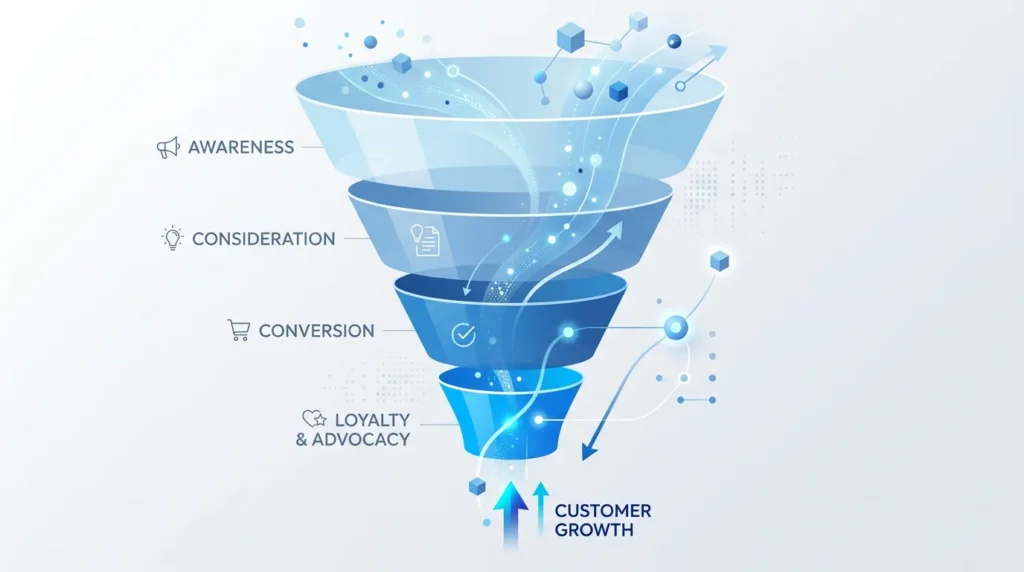
When you hear the term inbound marketing, you probably think of blogs and “good content”. Fair enough. But when you do inbound properly, it is not about content for content’s sake. It is about a system that helps your audience move forward while you build visibility, trust and conversations.
To be honest: inbound is not a button you switch to “more customers tomorrow”. It is an approach with a clear strategy, tough choices and measurable steps. You bring the goals, and we translate them into channel choices, content formats and a route toward pipeline.
In this article, we take you through what inbound marketing is, why it works, what usually does and does not hold up in practice, and what your next step is to start winning today.
What is inbound marketing and what is it really about?
Inbound marketing is a methodology where you attract people with valuable information, then help them choose, and after that make sure they get results. In many fully developed versions, this is summed up as attract, engage and delight. (hubspot.com)
1) Attract: you get found, not interrupted
In attract, you create demand. This usually happens through Search Engine Optimization (Search Engine Optimization) and content that covers intent, plus supporting channels such as paid campaigns and social distribution. The principle is simple: you make it easier for the right people to discover your brand at the moment they are “looking for” something.
2) Engage: you guide people toward a conversation
Engage is about relevance. Not “more traffic”, but the right information in the right place. You use landing pages, email follow-up and conversational steps so interested visitors turn into a Marketing Qualified Lead (Marketing Qualified Lead) and then a Sales Qualified Lead (Sales Qualified Lead), depending on your sales process.
3) Delight: you make sure customers do not drop off
Delight is the part many teams stumble over, because it is not sexy. But it is where retention, referrals and knowledge reuse come from. Many inbound models describe delight as support so customers succeed and others start recommending you. (hubspot.com)
Small but important nuance: inbound marketing is not “always organic”. You combine channels. Sometimes you use Search Engine Advertising (Search Engine Advertising) or social activity to get content on the map faster. The goal stays the same: you build trust with a content-driven route, not with interruptive shout campaigns.
Why inbound marketing works, and when it works against you
Inbound works because buying behaviour changes. People first figure things out for themselves, compare options and build a shortlist before sales contact begins. So you do not win by shouting, but by having the answers ready.
We use inbound models and buyer journey insights as the foundation. Still, it is honest to say that numbers differ by industry, audience and measurement approach. That is why our recommendation is not “bet on numbers”, but “build a measurable system”.
What usually works in practice
- Intent-led content: your content matches the questions your audience really has, not the topics you happen to like.
- Clear conversion routes: from article to landing page, from landing page to conversation, with short steps and a clear reason to click through or respond.
- Fast follow-up: inbound without a response moment is like opening a door and then leaving the key in another room.
- Sales and marketing work as one team: Marketing Qualified Lead criteria have to match what sales accepts, otherwise your pipeline moves forward “on paper” and not in real life.
Where inbound often works against you
- Audience too broad: you get traffic, but no conversations. You often see this on pages that are too generic.
- Top-of-funnel without follow-up: visitors come in, but you do not sell anything because the journey does not continue.
- Unclear definitions: if you are not sharp on what a Marketing Qualified Lead (Marketing Qualified Lead) and Sales Qualified Lead (Sales Qualified Lead) means, then we cannot measure the real win.
Trade-off you need to accept: inbound takes time. You build attention ownership through SEO and valuable assets. If you want to get “everything out of organic” today, you will disappoint yourself. That is why I always advise a mix of acquisition channels and conversion optimization, so you are not waiting for spring to begin.
The inbound marketing strategy you can execute, with a measurement plan
Instead of a big picture with vague steps, we set out a workable model. Think of a loop: content, conversion, qualification, sales follow-up, optimization.
Step 1: define your ICP and make it concrete
Start with your Ideal Customer Profile (ICP). This is not a marketing poster. It is a list of characteristics your sales team sees every day in deals that do close.
Work with three layers:
- Firmographic: industry, company size, region, maturity.
- Functional: who is involved, which department decides or influences.
- Need and trigger: what makes them want to solve it now?
Why this works: your content becomes more targeted, your landing pages become more relevant and your qualification becomes fairer. That reduces noise in your pipeline.
Step 2: build a content plan around TOFU, MOFU and BOFU
Use TOFU, MOFU and BOFU as Top, Middle and Bottom of the Funnel. No shadow terms, just a practical structure for what your person needs at that moment.
TOFU (Top of the Funnel): education that is easy to find
- SEO pages for core questions
- Explanatory articles and guides
- Comparison criteria, but fact-based
MOFU (Middle of the Funnel): proof and narrowing down
- Case studies (focus on situation, approach, outcome, without sales talk)
- Templates and checklists (only if they truly add value)
- Webinars or workshops (with a clear next step)
BOFU (Bottom of the Funnel): decision support and conversion
- Service pages per use case
- Demo or intake pages
- FAQs that remove objections (process, lead time, implementation)
Practical tip: create one “main page” per topic and link to supporting content. That way, your site becomes a route map instead of a collection of separate blogs.
Step 3: make your lead route measurable and logical
Inbound is about conversions, but conversions only matter if they lead to real interest. That is why you need a clear set of KPIs.
You can think in this chain:
- CTR (Click-Through Rate) from your search results and ads, where relevant
- CVR (Conversion Rate) of landing pages
- percentage that moves on to Marketing Qualified Lead (Marketing Qualified Lead)
- percentage that moves on to Sales Qualified Lead (Sales Qualified Lead)
- lead time and ultimately sales process outcomes (without promising what you cannot deliver)
Note: a visit is not a lead. A form is usually a lead, provided it is real commercial contact information or an actual request. This prevents your KPIs from becoming “nice” but meaningless.
Step 4: optimize with CRO and measurable experiments
CRO (Conversion Rate Optimization) means you improve conversions by testing hypotheses. Think about:
- shorter forms
- clearer offer on the landing page
- more proof in the right section
- faster, relevant follow-up via email
Why this works: you remove friction. In many inbound funnels, most waste is not in traffic, but in the step between interest and action.
Step 5: align marketing and sales
Marketing Qualified Lead (Marketing Qualified Lead) criteria must match what sales accepts. So make one simple qualification rule together:
- which use case fits
- who is the decision role or influencer
- when do they want to start
- which budget range or alternative indicator you use
If you do not align on this, you may build volume, but not pipeline quality.
Channel choices within inbound, from SEO to email
Inbound marketing is not a single channel. It is an orchestra. Here is how you usually use the instruments best.
SEO: your foundation for steady inflow
SEO (Search Engine Optimization) often delivers the most cost-efficient inflow in the long term, provided your content matches intent and your technical foundation is sound. So do not make your SEO plan only about rankings, but about a content and conversion structure.
If you want to take this up professionally, also read our practical guide: Search engine marketing agency: practical guide to growth.
SEA: support for speed, where it makes sense
Search Engine Advertising (Search Engine Advertising) can accelerate inbound. You do not use it to “force everything”, but to:
- test faster which themes convert
- give content visibility while SEO grows
- validate landing pages using intent in the ad copy
If you want SEO and Search Engine Advertising to work together intelligently, this background is useful: SEO SEA: smart collaboration between SEO and SEA.
Email: your conversion booster after interest
Email is often the fastest way to move from “visit” to “conversation”, because you control timing and message. We usually use email for:
- nurturing after a download or signup
- follow-up after form submission
- reminders toward an appointment without spamming
For a clear approach, this is a good starting point: Email Marketing Strategy: From Planning to Execution.
Social media: distribution and trust building
In inbound, social media is not the primary lead machine, but it is an important channel for building trust and distributing content. It works better if you see social as “promotion of value”, not as “always-on content dumping”.
Want to tackle that professionally? See: Social media marketing agency: strategy and approach.
Practical execution, from tracking to optimization
Let’s make this concrete. Inbound marketing rarely fails because of a lack of ideas. It fails because of a lack of execution discipline. This is the step-by-step approach we often sharpen first with teams.
Tracking and data, otherwise you optimize by feel
You need at least:
- a measurement base (for example with Google Analytics 4 and tags for conversions)
- conversions that are correct (form submission, appointment, demo request)
- a link between marketing events and sales follow-up (so your KPl’s actually have meaning)
If you use Search Engine Advertising, pay extra attention to conversion tracking. Many teams lose money because of an error code or misconfiguration. This guide helps with a common issue: Google Ads Error Code 400: Fix and Prevent.
Landing pages: one message, one route
A landing page should help your visitor choose. That means:
- no four different CTAs next to each other
- a clear promise that matches the ad or article
- proof where doubts arise
Lead qualification: make it predictable for sales
You cannot automate everything without losing quality. But you can automate where it makes sense, for example:
- automatic email follow-up after form submission
- CRM updates for new requests
- routing based on questions in the form
Important boundary: automation should support your human judgement. Do not let systems make budget decisions or contractual commitments without human approval.
Sales follow-up: speed and relevance win
Inbound leads are warm. And warmth fades. So make sure you have an approach with:
- fast first response
- substantive reference to what they were looking for or asking for
- a next step that fits their stage, not an immediate hard close
When you bring in help, choose based on process quality
Sometimes an in-house inbound plan is too large for the capacity available. Then it makes sense to look for specialist support. Pay particular attention to process and quality, not nice promises.
For example, if you are looking for a partner who can translate inbound marketing into growth in a practical way, take a look at: Inbound marketing company: expertise for growth. Brief.
For paid campaigns, you may also need an approach with a clear ad and conversion structure. This page is a useful check: Hire a Google AdWords Specialist: What to Watch For.
Inbound marketing versus “quick wins”, and how to decide on the mix
Here comes the coffee-break truth: you do not have to see inbound as your only source. But you do need to choose one clear priority.
The right mix for most businesses
In practice, a combination often works well of:
- SEO and content for steady inflow
- Search Engine Advertising for speed and theme validation
- email for conversion after interest
- Conversion Rate Optimization to reduce friction
What determines your priority?
Ask yourself the following:
- Do we have content that matches our ICP questions exactly? If not, that is your first bottleneck.
- Do we get traffic but no high-quality Marketing Qualified Leads (Marketing Qualified Leads)? Then your conversion route and qualification are to blame.
- Do we have interest, but sales converts little? Then the sales process and lead follow-up need improvement.
And yes, sometimes “budget” is the issue. Then you make smart choices: focus on the channels and pages that deliver the most pipeline quality, instead of spreading money thinly everywhere. Not sexy, but effective.
A realistic next step for you, starting today
If you do one thing today to improve inbound marketing, make your funnel measurable and testable. Concretely:
- Choose 1 ICP use case (not your whole offer).
- Create or improve 1 main page for an intent-rich question.
- Design 1 landing page with one conversion route and one clear reason to make a request.
- Define your Marketing Qualified Lead (Marketing Qualified Lead) and Sales Qualified Lead (Sales Qualified Lead) criteria with sales.
- Start 2 CRO experiments within 2 to 4 weeks, for example form length and order of proof.
Why this is the best next step: you create a small chain from attract to engage that you can learn from and optimize immediately. Inbound then becomes not a big project, but a series of controlled improvements.
Final thought: inbound marketing is a system, not an activity
Inbound marketing is built on one simple promise: you help your audience move forward at the moment they are ready for it. A company does that not with one blog post, but with a route that works, is measurable and creates alignment between marketing and sales.
If you get this right, your marketing becomes calmer. Less improvisation. More predictable conversion. Not magical, but professional.
Want one more route into execution? This addition may fit your situation, especially if you want to see a website as conversion infrastructure: Web design agency: growth with SEO, SEA and CRO. And if, alongside inbound, you also need to open new commercial conversations, this guide can help you approach people in a respectful way: Cold Email: Effectively Approach New Prospects (Guide).
