

When you hear “inbound marketer,” you quickly think of blogs, social posts, and a few handy landing pages. Good start. But inbound only becomes useful when it’s a system we can measure, adjust, and carry through to the sales pipeline. In this guide, we talk about that in practical terms, as if we’re sitting next to your desk with a cup of coffee and a clear checklist.
We focus on online marketing and online sales optimization for companies. So no vague story. You get an approach you can execute today. And you’ll also learn the pitfalls, so your team doesn’t end up with content and no commercial follow-up.
What exactly does an inbound marketer do, and what don’t they do?
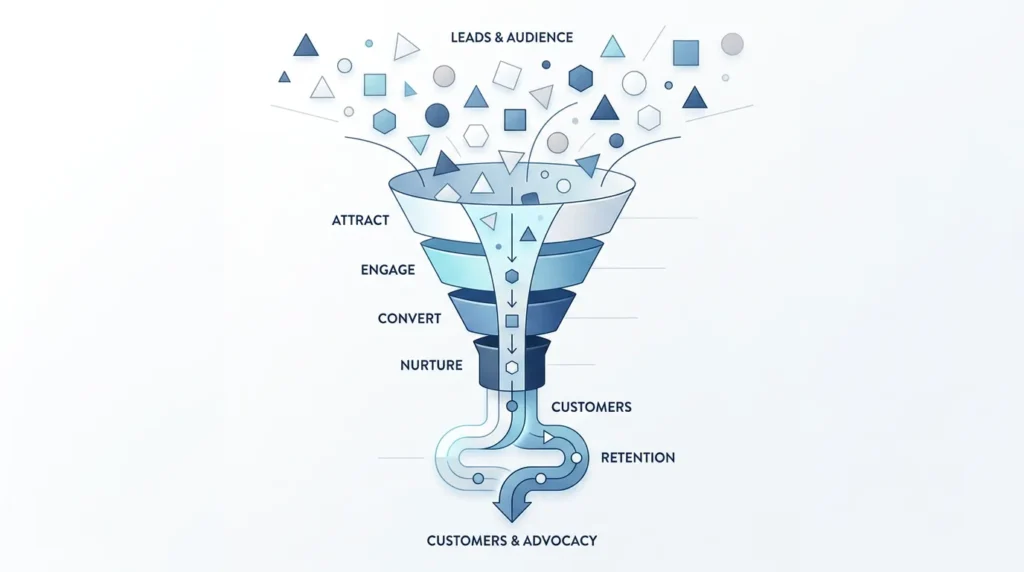
An inbound marketeer builds an approach that lets potential customers find you based on their questions and intent. Inbound is about a cycle in which we:
- attract with relevant content and search engine visibility
- engage through pages, forms, and nurturing that builds trust
- delight with helpful next steps, fast follow-up, and extra information that fits their next choice
You can see that logic in the inbound methodology “attract, engage, delight.” (hubspot.com)
What inbound marketeers usually do: content strategy, SEO (Search Engine Optimization), conversion optimization, lead capture, marketing reporting, and alignment with sales for lead follow-up.
What inbound marketeers usually do not do: just publish and hope it works by itself. Hope is not a channel. At best, it’s an emotional phase.
The strategy behind inbound that actually works: from intent to follow-up
Let me be blunt: inbound is not “more traffic.” Inbound is more qualified commercial opportunities that we can follow up on. That means we design your approach around intent and behavior.
1) Start with ICP and intent, not with topics
You need an Ideal Customer Profile (ICP). Not as a document for the drawer, but as a decision rule.
Translate your ICP into search intent in three zones:
- Top, Middle, and Bottom of the Funnel (TOFU, MOFU, BOFU): these aren’t magical definitions, but useful working terms. TOFU helps you get found, MOFU helps you build trust, BOFU helps you choose.
- Problem and solution language: which words does your audience use when they’re still unsure versus when they’re already comparing?
- Intended action: what is the next step that is realistic for a prospect at that stage?
Practically: create one “goal page type” per stage. For example, an explainer page for TOFU, a comparison guide or template for MOFU, and a case study or product page for BOFU.
2) Build content that solves questions, not content that is only informative
Good inbound content does three things at once:
- It answers the question someone is searching for.
- It reduces uncertainty about “does this fit me?”.
- It points to a logical next step that sales or customer success can use.
You don’t have to invent every format. What matters most is linking each piece of content to a measurable conversion.
3) Make your conversion path measurable, or you’re fishing blindfolded
An inbound funnel with traffic but no measurement points is a prop. So work with:
- GA4 events and Key Events as revenue-related micro and macro actions. In Google Analytics 4, a conversion is built from an event, so you can measure important actions consistently. (support.google.com)
- Landing pages with one primary CTA (Call to Action) per page. One message, one action, one reason to move now.
- CRM logging for lead status: from intake to Sales Qualified Lead (SQL) and beyond. Without CRM context, marketing reporting is guesswork.
Practical tip: define per page type which event makes the page a “success.” Think “form submitted successfully,” “demo requested,” or “download completed.”
4) Use nurturing as a bridge, not a spam machine
Nurturing is email and sometimes retargeting that helps your prospect decide. It only works when your content matches their previous interaction. That means you:
- create segments based on behavior and stage (TOFU, MOFU, BOFU)
- keep the time between follow-ups logical (faster for BOFU, slower for TOFU)
- scale down once sales has the conversation, otherwise you overlap responses and that frustrates everyone
If you want a solid foundation here, this article helps: Email Marketing Strategy: From Planning to Execution.
SEO for inbound: visibility that leads to commercial intent
SEO is often the longest game. That’s why it needs to be tied to lead quality from day one, not just rankings.
What works in inbound SEO, specifically
Here’s what we most often see working in projects:
- Cluster structure: one core page per topic and multiple supporting pages that link internally. That gives your site a story, not just a pile of separate articles.
- BOFU variants: not just explanations, but also “choice” content such as implementation overviews, cost structure explanations (without promises), and clear step-by-step plans.
- Conversion-focused SEO: your meta title, headings, and intro should make the intended action feel logical. If someone lands and doesn’t understand the CTA, you’ve missed the intent.
Indexing and technical hygiene: boring, but worth money
When Google doesn’t crawl and index your pages consistently, you can publish content until you drop. So make sure the basics are in order. In Google Search Console, you can submit a sitemap, and Google will try to crawl that sitemap after submission. (support.google.com)
Practical checklist for your next sprint:
- Check in Search Console whether your sitemap is being read correctly.
- Check whether your key page types are in the index.
- Fix “dead” content or incorrect canonical signals so your internal links pass value.
Do you want a practical roadmap for engine room and campaign together? Then read: Search engine marketing agency: practical guide to growth.
Lead generation in inbound: from visitors to Marketing Qualified Lead and beyond
Now for the part where teams often stumble: an inbound website does generate touchpoints, but not always commercial contact moments. So we need to define “lead” properly in a B2B and B2C context: a person or company with genuine commercial interest, with enough identifying data to follow up.
Define your funnel terms so everyone means the same thing
Make these agreements explicit:
- Lead: a contact with commercial interest, with usable contact details or a clear commercial request.
- Marketing Qualified Lead (MQL): a lead that meets pre-set criteria based on behavior and fit (for example the right industry, the right use case, or repeated visits to BOFU pages).
- Sales Qualified Lead (SQL): MQL plus sales considers the file valuable enough to schedule a real conversation.
Why is this important? Because otherwise you get reporting like: “we have lots of leads, but sales says there are few opportunities.” That’s not a disagreement. It’s a definition problem.
What you need to build: landing pages, forms, and a follow-up rhythm
A strong inbound lead flow has three parts:
- Landing page with one promise and one logical CTA.
- Form with the minimum necessary fields. Too many fields lowers your Conversion Rate (CVR). Too few fields makes follow-up difficult. Choose intentionally.
- Follow-up from sales or marketing automation within an agreed time window.
In practice, we saw that speed at BOFU is often worth more than extra spend. Not because speed is “magical,” but because the chance that someone is still in the same decision moment increases.
Adding outbound too, but neatly: why you don’t have to put everything on inbound
Inbound takes time. If your pipeline needs to move now, cold outreach can play a role. But treat it as a supplement, not a replacement. If you want to handle this well, this helps: Cold Email: Effectively Approaching New Prospects (Guide).
Important: automation should only help with efficient follow-up. A system must not make budget, contracts, or other high-impact decisions on its own without human approval.
Automation and reporting: how to make sure inbound doesn’t just run, but also learns
Automation in inbound is about speed, consistency, and better follow-up. The goal is not “everything automatic.” The goal is better lead quality and shorter time from click to conversation.
Which automations we usually implement first
- Lead capture automation: form submission to CRM, including source and campaign context.
- Lead qualification workflows: mark MQL based on behavior, with rules you can explain to the team.
- Nurturing sequences: trigger based on stage and interest, not on “someone clicked once.”
- Reporting automation: the same KPI’s (Key Performance Indicator) for marketing and sales, so the team doesn’t manage two truth systems side by side.
For event tracking in GA4 and collaboration with Google Tag Manager, you can follow the official guidance for events and conversions. (developers.google.com)
Which KPI’s are actually useful for an inbound marketeer
You don’t need to track ten KPI’s. You mainly need a chain:
- Traffic is not a lead. Only when you get contact details or a clear request do we talk about a lead.
- CVR per page type: TOFU landing pages have different goals than BOFU pages.
- Quality of MQL and SQL: look at the share of leads that sales actually picks up.
- Time to conversion: from request to first real interaction.
- Cost per action: choose one definition for your reporting. If you use PPC (Pay-Per-Click), for example, you can measure Cost Per Lead (CPL) for lead quality, but only if your lead definition is correct.
Trade-off, honestly: more conversions through lower thresholds can increase MQL volume, but SQL share can fall. That’s why you always need to connect KPI’s to sales outcomes, not just form submissions.
Align SEO and SEA smartly, so your budget doesn’t leak away
Sometimes you want speed before SEO can deliver it. Then you use Search Engine Advertising (SEA). Not to replace SEO, but to fill gaps. The smart part is that you use the same intent and the same landing page logic, so your learning stays reusable.
Read this for practical cooperation between SEO and SEA: Seo sea: smart collaboration between SEO and SEA.
And if you’ve recently had an issue with your Google Ads tracking, check this guide: Google Ads Error Code 400: Fix and Prevent.
A practical execution plan: your first 30 days as an inbound marketeer
Okay, enough theory. Below is a plan we often set up over 30 days, because it creates momentum and lets you quickly measure what works.
Week 1: foundation and measurability
- Make ICP and stage goals (TOFU, MOFU, BOFU) concrete on one page.
- Define landing page types and their primary CTA per stage.
- Check tracking: GA4 events and conversions, with consistent naming. (support.google.com)
- Check indexing basics via Search Console and sitemap if needed. (support.google.com)
Week 2: content and conversion assets
- Produce or update 3 pages: one TOFU explainer, one MOFU guide (with template or checklist), one BOFU choice asset (case study, process page, or comparison page).
- Adjust forms and page flows based on one primary conversion goal.
- Plan follow-up: who calls, who emails, and within which SLA (Service Level Agreement) or time window.
Week 3: nurturing and retargeting based on intent
- Start an email nurturing flow per stage with logical content follow-up.
- Segment based on behavior, not just demographics.
- Use one clear “next step” per email.
Week 4: optimize on results, not gut feeling
- Review per page type: CVR, MQL quality, and the share that moves on to SQL.
- Optimize one variable at a time. For example, headline and CTA order on BOFU pages.
- Decide whether SEA is needed to learn faster on high-intent keywords, and connect SEA to the same funnel assets.
If you also use social as distribution and extra signals, this overview helps: Social media marketing agency: strategy and approach.
When to bring in help: what to look for in an inbound agency
Sometimes it’s faster to buy capacity than to build it internally over months. That makes sense. But then you don’t want a “more content” machine. You want a team that sees inbound as a commercial system.
When evaluating an agency, look at these points:
- They connect content to conversions, not just to publishing.
- They speak in terms of MQL, SQL, and measurable funnel steps.
- They work with technical SEO hygiene and tracking discipline.
- They show you how they prioritize based on impact and feasibility.
If you want a selection process, start here: Best Online Marketing Agency: Selection Guide and Comparison.
And if you mainly need a proposal quickly, this can help: Inbound Marketing Company: Expertise for Growth. Brief.
For extra background on the inbound approach, you can also use this guide: Inbound marketing: the practical guide to more pipeline.
Finally, if you’re looking for the bigger picture on modern online marketing solutions: Digital Marketing Agency: Modern Marketing Solutions.
Conclusion: being an inbound marketer is mainly about steering the system
As an inbound marketeer, you don’t win by posting more. You win by building a system that:
- attracts the right people based on intent
- builds trust through content and a clear conversion path
- turns leads into MQL and SQL with clear definitions
- uses automation for speed and consistency
- optimizes on data, with KPI’s that sales understands too
Your next step: choose one focus. Do you want more BOFU conversions, or do you want to get your tracking and lead quality in order first? If you decide that, the rest of the plan gets much easier. Inbound is not a roadmap of a hundred pages. It’s a roadmap of decisions you repeat every week.
